
TL;DR
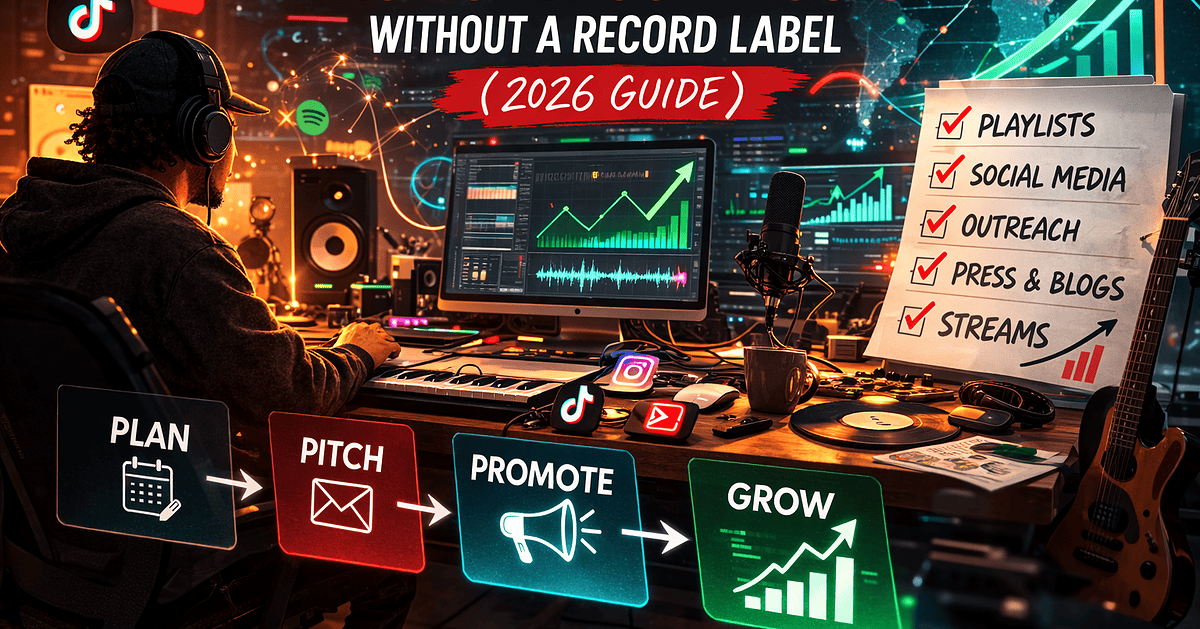
To promote your music without a record label in 2026: (1) finish the song to commercial standard, (2) plan an 8-week release campaign, (3) pitch Spotify editorial 3–4 weeks pre-release, (4) build social momentum on TikTok and Reels, (5) email independent playlist curators and music blogs, (6) launch every channel on release day, (7) sustain post-release with daily analytics review and continued outreach. The independent artists who win aren’t the most talented — they’re the most systematic.
The music industry in 2026 looks nothing like it did a decade ago. According to the IFPI Global Music Report 2026, the global recorded music industry hit $31.7 billion in revenue in 2025, with paid streaming subscriptions reaching 837 million users worldwide. Independent artists now account for over 40% of global streaming revenue, and that share continues to climb (Music Business Worldwide, 2026).
The gatekeepers haven’t disappeared — but the gates are wide open for any artist willing to learn the game. The catch: independence alone isn’t a strategy. Without a label’s infrastructure, every aspect of music promotion for independent artists falls on you, from playlist pitching and algorithm optimisation to social media content and press outreach.
This guide is the most comprehensive, no-fluff breakdown of exactly how to promote music without a record label in 2026. Whether you’re releasing your debut single or your fifteenth, you’ll find tactics, real timelines, citations and tools to build a promotion engine that works — without a record deal. For complementary brand work, pair this with our 2026 artist branding guide.
Why Independent Artists Need a Promotion Strategy in 2026
Over 100,000 tracks are uploaded to Spotify every single day. Without a deliberate music marketing strategy, your release disappears into the algorithmic noise within 48 hours. Labels provide marketing infrastructure by default — as an independent artist, you have to build that infrastructure yourself.
A promotion strategy isn’t about spending money on ads. It’s about coordinating every action — from the moment you finish a song to months after release — so each effort compounds on the last. The artists who treat promotion as an afterthought are the ones wondering why nobody is listening.
The good news: the tools and knowledge required to promote music without a label are more accessible than ever. What used to require a team of five now requires a plan, consistency and the right systems.
How Music Promotion Actually Works Today
Modern music promotion operates across three interconnected layers. Understanding how these layers reinforce one another is the foundation of every effective independent campaign.
1. Algorithmic Discovery
Streaming platforms use machine learning to match listeners with music they’re likely to enjoy. Your job is to feed the algorithm the right signals: consistent saves, repeat listens, playlist adds, low skip rates, and library additions in the first 7 days after release.
2. Playlist Placement
Playlists remain the single largest driver of streams for independent artists — including editorial playlists (curated by platform staff), algorithmic playlists (Discover Weekly, Release Radar, Daily Mix), and independent curator playlists (managed by music fans, brands and tastemakers).
3. Audience-Driven Sharing
Real fans share music. Social media virality, word of mouth, and user-generated content on TikTok and Instagram Reels create organic discovery that no amount of paid promotion can replicate.
“You don’t choose the algorithm. The algorithm chooses you — based on whether real humans react to your music in the first 48 hours.”
Understanding Streaming Algorithms: Spotify, Apple Music & YouTube Music
If you want a serious Spotify promotion strategy, you need to understand exactly how the algorithm decides which songs to push. The official mechanics are documented in the Spotify for Artists help centre.
Release Radar
Release Radar is a personalised playlist refreshed every Friday. When you release new music, Spotify automatically adds it to the Release Radar of your followers and listeners who have previously engaged with you. The more engaged followers you have, the larger your automatic Day-1 reach.
Discover Weekly
Discover Weekly is generated every Monday based on listener habits. To land in it, your song needs strong engagement signals — saves, repeat plays, playlist adds — from listeners whose taste profiles overlap your target audience. This is exactly why early engagement in the first 7 days of release is critical.
Algorithmic Playlists and Radio
Beyond Release Radar and Discover Weekly, Spotify populates dozens of algorithmic playlists (Daily Mix, song radio, genre mixes) based on listening patterns. Consistent engagement over time — not just at release — determines how often your music appears.
Apple Music & YouTube Music
Apple Music for Artists uses a similar approach with its “New Music Daily” and personalised stations. YouTube Music is increasingly powerful in 2026 — particularly for genres where music videos drive discovery. The principle on every platform is identical: early, genuine engagement triggers wider algorithmic distribution.
Get Pitched to the Right Spotify Playlists
Harment’s professional Spotify playlist pitching service places your track in front of editorial and independent curators — no bots, no fake streams.
Explore Harment Services →Building a Release Strategy Before You Promote a Single Thing
Promotion doesn’t start on release day — it starts weeks before. A structured release strategy ensures every promotional action is timed for maximum impact.
Key Elements of a Release Strategy
- Distribution timeline: Upload to your distributor (DistroKid, TuneCore, or similar) at least 4 weeks before release to allow Spotify editorial pitching.
- Content calendar: Plan teaser content, behind-the-scenes material and promotional posts for the 6 weeks surrounding release.
- Playlist pitch window: Spotify requires at least 7 days before release to consider editorial pitches — aim for 3–4 weeks.
- Pre-save campaign: Drive pre-saves in the 2 weeks before release to boost Day 1 algorithmic signals.
- Post-release plan: The first 7 days are critical. Plan follow-up content, curator outreach and engagement tactics in advance.
Before committing to a release, confirm the track is ready. Use the free HarmENT Instrumental Analyzer or AI Song Checker for mix-quality and commercial-readiness feedback, then plan the whole rollout with Release Aid.
Playlist Promotion Strategy: Editorial, Algorithmic & Independent
Playlist promotion is the backbone of independent music marketing. Three types of playlists exist, each with a different approach.
Editorial Playlists
Curated by Spotify’s in-house team. Pitch unreleased music through Spotify for Artists. A strong, well-framed pitch matters — tools like Pitch500 help structure your submission with the right language, genre framing and reference artists.
Algorithmic Playlists
You can’t pitch these directly. They’re triggered by engagement metrics. Focus on driving saves and repeat listens in the first 72 hours to signal to the algorithm that your track deserves wider distribution.
Independent Curator Playlists
Thousands of independent curators run playlists with genuine, niche followings. Reaching out directly is one of the highest-ROI tactics available. Professional email templates such as Dropmail dramatically improve response rates when pitching at scale.
Social Media Promotion Strategy for Indie Artists
Social media is not optional for independent artists in 2026 — but posting randomly is almost as bad as not posting at all. An effective strategy follows the 70/20/10 rule:
- 70% value content: Behind-the-scenes footage, production breakdowns, storytelling, tutorials, opinions on music trends.
- 20% community content: Engaging with fans, replying to comments, duetting other creators, collaborations.
- 10% promotional content: Direct calls to stream, pre-save links, release announcements.
Most artists invert this — 90% promotion, 10% everything else — and wonder why engagement is flat. Audiences follow people, not advertisements.
Platform-Specific Tactics
- Instagram: Stories for daily engagement, Reels for discovery, carousels for shareable content (lyric breakdowns, production tips).
- YouTube: Long-form content (music videos, vlogs, studio sessions) builds deep audience connection and drives search traffic — see YouTube Creator Academy.
- Twitter/X: Real-time engagement, industry commentary, thread-based storytelling.
- Threads & Bluesky: Worth a low-effort cross-post in 2026, particularly for community building inside scenes.
TikTok and Short-Form Content: Still the #1 Discovery Engine
TikTok remains the most powerful organic discovery platform for music in 2026. But success isn’t about going viral — it’s about consistent content that introduces your music to new audiences.
Effective TikTok Hooks for Musicians
- “I made a song using only [unusual instrument/sample]”
- “POV: You’re writing a hit at 3am”
- “This chord progression changes everything”
- “How I produced [song name] from scratch”
- “Reacting to my song getting playlisted for the first time”
The core principle: lead with content, not with the song. The best TikTok music promotions don’t feel like promotions — they feel like interesting content where the music happens to be playing. Post 4–7 times per week, use trending sounds strategically, always bring viewers back to your original track, and pin your best-performing video featuring your latest release.
Need a Full Social Media Engine?
Harment’s Social Media Management and Influencer Marketing packages keep your brand consistent and growing across TikTok, Instagram and YouTube while you focus on the music.
Explore Harment Services →Email Outreach to Playlist Curators (Template That Works)
Direct email outreach to independent playlist curators is one of the highest-ROI activities in indie music marketing. Here’s a template that works:
Subject: Song Submission — [Your Artist Name] — [Song Title]
Hi [Curator Name],
I’ve been following your playlist [Playlist Name] for a while and really appreciate the curation. I have a new track called “[Song Title]” that I think would sit well alongside [Specific Artist Currently on Playlist].
It’s a [genre] track with [one-sentence description of mood/style]. Here’s the Spotify link: [link]
No pressure at all — just thought it might be a good fit. Thanks for your time.
[Your Name]
Key principles: keep it short, personalise every email, reference specific tracks already on their playlist, and never send mass copy-paste messages. For streamlined outreach at scale without losing personalisation, use Dropmail templates.
Blog and Press Coverage Strategy
Music blogs and online publications still carry weight in 2026 — not for direct streams, but for credibility, SEO backlinks, and social proof. A feature on a respected blog gives you something to share, link to and reference in future pitches.
How to Pitch Music Blogs
- Research blogs that cover your genre. Don’t pitch a hip-hop track to an indie folk blog.
- Read their recent articles and reference specific pieces in your pitch.
- Provide a press kit: high-quality photos, a concise bio, links to your music, a one-paragraph track description.
- Follow up once after 5–7 days. If no response, move on.
Target 20–30 blogs per release. Even a 10% placement rate means 2–3 features per single, which compounds over multiple releases. Reference titles include Pitchfork, Clash, The Line of Best Fit, DIY Magazine and Rolling Stone — but smaller niche blogs often convert better at the indie level.
Build an Audience, Don’t Just Chase Streams
Streams are a vanity metric unless they convert to fans. The difference between 100,000 streams from playlist listeners who never return and 5,000 streams from engaged fans who follow you, save your music and attend your shows is enormous.
Focus on building owned audience channels:
- Email list: The single most valuable asset an independent artist can build. Offer exclusive content, early access or behind-the-scenes material in exchange for sign-ups. Mailchimp or Buttondown are both fine starting points.
- Discord or community platform: Create a space for your most engaged fans to interact with you and each other.
- YouTube subscribers: YouTube’s algorithm rewards consistent uploading. A subscriber base translates to reliable views on every new upload.
Understanding what streams actually pay can help you decide where to invest time. The free HarmENT Royalty Calculator gives a realistic picture of what different stream counts translate to in revenue.
Paid vs Organic Music Promotion: When to Use Each
Both paid and organic promotion have a place in a 2026 music marketing strategy. The key is knowing when to use each.
Organic Promotion
Social media content, playlist pitching, email outreach, blog submissions, collaborations and community building. Organic is free but time-intensive — it builds long-term, sustainable growth.
Paid Promotion
Meta ads (Instagram/Facebook), TikTok ads, YouTube pre-roll, and professional promotion services. Paid accelerates results but requires careful targeting to avoid wasted spend.
The golden rule: Only pay to amplify something that’s already working organically. If a piece of content is performing well, boost it. If a song is gaining traction naturally, invest in broader promotion. Never use paid promotion to compensate for a song that isn’t connecting — you’ll just burn cash on a track that won’t retain listeners.
Common Music Promotion Mistakes Independent Artists Make
- Releasing without a plan. Uploading a song and hoping is not promotion. Every release needs a minimum 4-week strategy.
- Buying fake streams or followers. Platforms detect artificial engagement. It damages your algorithmic standing and can get your music removed entirely.
- Ignoring metadata. Genre tags, mood descriptors and artist bios directly influence algorithmic recommendations. Fill out every field in your distributor and Spotify for Artists.
- Only promoting on release day. Promotion is continuous. Pre-release, release week and post-release each need different tactics.
- Neglecting visual identity. Cover art, artist photos and social media aesthetics matter — they signal professionalism. See our artist branding guide.
- Spreading too thin. Pick 2–3 channels and execute well rather than doing everything poorly.
Long-Term Growth Strategy for Independent Artists
A single viral moment won’t build a career. Independent artist marketing is the compounding of small wins over time. Long-term growth looks like:
- Release consistently: Aim for a new single every 6–8 weeks. Each release is a new chance to trigger algorithms.
- Build relationships: Collaborate with other artists at your level. Cross-pollinate audiences. Feature on each other’s tracks.
- Invest in your craft: Better songs make every promotional effort more effective. Allocate budget to production, writing and performance.
- Track your data: Use Spotify for Artists, Instagram Insights and YouTube Analytics. Double down on what converts; cut what doesn’t.
- Think like a business: Set quarterly goals, manage a promotion budget, treat your music career as the enterprise it is.
Step-by-Step Music Promotion Strategy (Use This for Every Release)
Step 1 — Prepare the Song
Ensure your mix and master are professional quality. Cross-check against commercial references using the Instrumental Analyzer or AI Song Checker. Finalise cover art, credits and metadata.
Step 2 — Plan the Release Campaign
Map your full promotion timeline from upload to post-release using Release Aid so nothing is missed.
Step 3 — Pitch Playlists
Submit to Spotify editorial via Spotify for Artists using Pitch500 to craft a compelling pitch. Compile your independent curator list for post-release outreach.
Step 4 — Build Social Momentum
Start teaser content 4–6 weeks pre-release. Apply the 70/20/10 rule. Create 3–5 TikTok/Reels using snippets of the track.
Step 5 — Outreach to Curators and Blogs
Send personalised emails to playlist curators and music blogs. Use Dropmail templates for efficient, professional outreach.
Step 6 — Launch Promotion Campaign
On release day activate every channel: social posts, Stories, email to your list, any paid promotion. Consider Harment’s promotion packages for wider reach.
Step 7 — Post-Release Growth
Monitor performance daily for the first 2 weeks. Double down on what’s performing. Continue curator outreach. Reply to every comment and DM. Plan the next release.
The 8-Week Independent Release Promotion Timeline
| Week | Action |
|---|---|
| Week 8 | Upload to distributor. Begin Spotify editorial pitch. |
| Week 6 | Start teaser content on social media. Behind-the-scenes posts. |
| Week 4 | Submit editorial pitch (if not done). Begin curator research. |
| Week 3 | Launch pre-save campaign. Intensify social content. |
| Week 2 | Social media rollout. Email your list. Post daily content. |
| Week 1 | Final push. Influencer outreach. Countdown content. |
| Release Week | Full launch. All channels active. Paid promotion if budget allows. |
| Post-Release | Monitor data. Continue outreach. Engage audience. Plan next release. |
Pre-Promotion Checklist
Before you start promoting, make sure you’ve ticked every box:
Ready to Launch a Professional Release?
Harment’s Complete Launch Package combines distribution, Spotify pitching and PR — engineered for independent artists who want label-quality promotion without the label.
Explore Harment Services →Frequently Asked Questions
How do independent artists promote their music in 2026?
Can you really promote music without a record label?
How much does music promotion cost in 2026?
Is Spotify playlist promotion worth it?
What is the best way to promote music in 2026?
How long before release should I start promoting?
Do independent artists still need a PR campaign?
Conclusion: Build Your Promotion Engine
Promoting your music without a record label isn’t easy — but it’s entirely possible, and in 2026 it has never been more achievable. The artists who succeed treat promotion as a skill to be learned and a system to be built, not a chore to be avoided.
Start by building your release strategy. Use Release Aid to plan, Pitch500 to craft your Spotify editorial pitch, and Dropmail to streamline curator outreach. Explore HarmENT’s free music tools to give your next release the best possible chance.
When you’re ready to step up, HarmENT’s professional music promotion services add the infrastructure and network that independent artists typically lack. Your music deserves to be heard. Now go build the strategy that makes it happen.
Explore related Harment guides & services
- How to Build a Strong Artist Brand in 2026
- Spotify Promotion & Playlist Pitching
- Music PR & Press Outreach
- Artist Branding & Visual Identity Services
- Browse all 29+ promotion & development services
Ready to Promote Your Next Release the Right Way?
Browse Harment’s full range of 29+ professional music promotion, branding and artist development services — all with a price match guarantee.
Explore Harment Services →