
TL;DR
To tell what genre a song is in 2026, use the fastest of eight methods: (1) paste the link or audio into a free auto genre detector like Chosic, Soundcharts, Cyanite, Musiio or Harment’s Instrumental Analyzer; (2) Shazam the clip then read the genre tag in Apple Music, Spotify or Every Noise at Once; (3) tap out the BPM and check the BPM-by-genre chart; (4) list the instrumentation; (5) note the vocal style; (6) spot the production fingerprints (sidechain pump, 808 slide, vinyl crackle, big-room drop); (7) read the lyrical themes; (8) read the context — cover art, label, playlists, hashtags, era. Use Harment’s interactive Genre Finder below to combine them in one click.
Key Takeaways
- Fastest method (released track): Chosic Music Genre Finder or Every Noise at Once — gives you Spotify’s internal micro-genre cluster instantly.
- Fastest method (unreleased / file): Harment’s Instrumental Analyzer or Cyanite — analyses raw audio rather than catalogue lookups.
- Best free ear-only formula: BPM band + instrumentation + vocal style identifies ~85% of modern songs.
- Most common 2026 genre confusion: drill vs trap (BPM half-time), indie pop vs bedroom pop, lo-fi vs chillhop, future bass vs colour bass, hyperpop vs digicore.
- Spotify currently tracks over 6,000 micro-genres (sigilkore, sleep-pop, escape-room, slowed and reverb, dariacore) via Every Noise at Once.
- Genre still drives discovery — playlist pitching, sync, TikTok recs and DSP algorithms all run on genre tags first.
- Pick the most specific honest genre for your own music — see our guides on getting more Spotify streams and direct-to-fan monetisation.
“What genre is this?” is the second most-Googled question in music after “what’s that song called” — and almost every guide on the internet answers it with the same two-sentence cop-out: “Listen to the instruments. Compare to similar artists. You’ll figure it out!” That isn’t a guide. That’s a shrug. Soundcharts will tell you to upload a file. Chosic will hand you Spotify’s tags. SubmitHub will run you through a quiz. Crossfader will hand you four bullet points. Musical U will tell you to count the snare hits. Even Wikipedia’s own genre article takes 8,000 words to never quite explain how to do it.
Identifying the genre of a song is a real, learnable skill — and once you have the framework it takes seconds, not minutes. This is the complete 2026 deep dive on how to tell what genre a song is: the eight methods ranked by speed and accuracy, an interactive Genre Finder built into this page (you tap a few buttons, it ranks the most likely genres in real time), the full sub-genre family tree from pop to plugg, the BPM-by-genre and key-by-genre charts, the seven production fingerprints that split sub-genres cleanly, and the five mistakes that make even Spotify’s own algorithm disagree with Apple’s. By the end you’ll be able to call genre on any track in under thirty seconds — and tag your own songs correctly so they actually get pitched, placed and played.
What “Genre” Actually Means in 2026
A music genre is a category of music defined by a shared set of conventions — instrumentation, rhythm, tempo, harmony, production style, vocal delivery, lyrical subject matter, cultural origin and audience expectation. None of those signals on its own makes a genre, but cluster four or five of them and you have a recognisable family: this is house, that is country, that other thing is drill (Music genre, Wikipedia).
Modern genre operates at three zoom levels:
- Genre — the broad family. Pop, hip hop, rock, electronic, R&B, country, jazz, classical, folk, metal, Latin, Afrobeats, gospel, blues, reggae.
- Sub-genre — the stylistic branch. Hip hop splits into trap, boom-bap, drill, lo-fi, conscious, cloud rap, plugg, rage. Electronic splits into house, techno, trance, dubstep, drum & bass, garage, ambient, IDM, hardcore.
- Micro-genre — the tightly-defined scene or aesthetic, often born on streaming or a single internet community. Spotify tracks 6,000+ of these including sigilkore, sleep-pop, escape-room, slowed and reverb, dariacore, jersey club, drift phonk, plugg, weirdcore, hexd.
Genre is not the same as vibe (mood/energy: melancholic, euphoric, aggressive) or era (decade signifiers), though both are powerful secondary signals. Spotify, Apple Music and TikTok all index vibe and era separately but build their core recommendation engines on genre — which is why mis-tagging your own release is one of the most expensive mistakes you can make as an independent artist. We unpack that whole topic in Why Your Music Isn’t Blowing Up in 2026.
Why Identifying Genre Matters
Genre detection sits underneath nearly every practical music decision:
- Playlist pitching: editorial curators on Spotify, Apple Music, Amazon and Deezer filter pitches by genre first. Tag wrong and your song never enters the right inbox. See how to get more streams on Spotify in 2026.
- Sync & licensing: production libraries (Musicbed, Artlist, Audio Network, Soundstripe) categorise every cue by genre + mood + tempo. Wrong tag = no placements.
- TikTok / Reels recommendation: the algorithm clusters audio by acoustic similarity and genre tag; mis-tagging suppresses cold reach.
- Distribution metadata: DistroKid, TuneCore, Ditto and CD Baby all require a primary genre at upload. It propagates to every DSP.
- DJing & setlist building: Camelot key plus genre keeps a set coherent. See how to find the key of a song in 2026.
- Songwriting reference: identifying the genre of a song you love is the first step to writing one. We break that down in how to write a song in 2026.
- Audience targeting: Meta, TikTok and Google ads all let you target by genre interest. See our build a fanbase from zero guide.
Method 1 — Free Auto Genre Detectors (The Fastest)
For any released, indexed track, an AI genre detector is the fastest route — under ten seconds, no install, on phone or desktop. The 2026 leaders all draw from one of three data sources: Spotify’s internal classifier (exposed through Every Noise at Once and licensed by Chosic), Apple Music editorial tags, or proprietary deep-learning models trained on millions of human-labelled WAVs.
| Tool | How It Works | Best For | Cost |
|---|---|---|---|
| Chosic Music Genre Finder | Paste Spotify URL → returns Spotify’s genre + sub-genres + mood | Released songs (Spotify-indexed) | Free |
| Every Noise at Once | Visualises every Spotify micro-genre as a scatter map; click any artist for their tags | Discovering micro-genres & clusters | Free |
| Soundcharts Genre Finder | Aggregates Spotify + Apple + Deezer + Shazam metadata | Cross-platform consensus | Free / Pro tier |
| SubmitHub: What’s My Genre | Audio-feature analysis + interactive quiz | Artists tagging their own releases | Free |
| Soundcamps Genre Finder | Upload audio or paste link → AI genre + similar artists | Audio uploads under 50MB | Free |
| Cyanite | Deep-learning analyser used by sync libraries | Pros — accurate sub-genres + mood | Free trial / paid |
| Musiio (SoundCloud) | Embedded in SoundCloud’s upload pipeline | SoundCloud-first artists | Free for uploaders |
| Harment Instrumental Analyzer | Drop any file or link → returns 2026-current genre, sub-genre, BPM, key, mood, energy + chord suggestions | Unreleased material & songwriters | Free |
If the song is on Spotify, Chosic and Every Noise at Once are unbeatable for speed and depth — they expose Spotify’s micro-genre clusters that no other free tool has access to. If the song is not indexed (unreleased demo, fresh upload, TikTok rip, voice memo, private stem), tools like Tunebat or Chosic won’t help. That’s when you reach for Cyanite, Musiio or Harment’s Instrumental Analyzer, all of which analyse the raw audio you upload rather than performing a catalogue lookup.
Identify Genre, BPM, Key & Mood in 10 Seconds
Harment’s free Instrumental Analyzer reads genre, sub-genre, BPM, key, energy and mood from any file or link — and suggests chord progressions and writing prompts to build over the top. No sign-up. Works on unreleased audio that Chosic and Tunebat can’t see.
Open Instrumental Analyzer →Method 2 — Shazam It, Then Read the Platform Tags
If you can hear the song playing but don’t know the title, Shazam is still the fastest first step in 2026. Hold up your phone, get the title in 5 seconds, then open the result in Apple Music (built-in), tap the artist, and read the genre at the top of the artist page. For deeper sub-genre detail, search the same artist on Every Noise at Once — its profile pages display every Spotify micro-genre that artist has ever been clustered into.
Alternatives: AHA Music (browser extension), SoundHound (hums and a cappella too), Google Assistant (“what’s this song?”), and YouTube Music’s audio search. All four return artist + title, which is all you need to look up the genre on Spotify, Apple Music or Every Noise at Once.
Method 3 — Identify the BPM Band
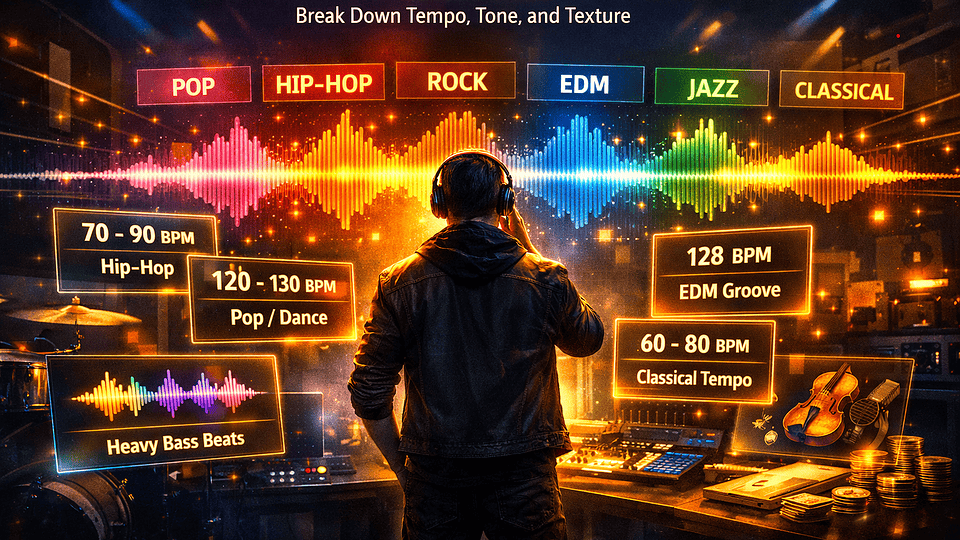
Tempo is the cheapest and most decisive signal you have. Tap along to the beat for 8 seconds in a free BPM tap tool (or use the BPM tapper built into Harment’s Analyzer), then match against this chart. BPM alone won’t lock in a genre, but it eliminates roughly half the family tree in one tap.
| BPM Range | Genres & Sub-Genres You’ll Hear | Typical Feel |
|---|---|---|
| 40 – 70 | Ambient, drone, neoclassical, slow blues, downtempo, doom metal, slowed & reverb, sleep-pop | Spacious, glacial, weightless |
| 70 – 90 | Hip hop / boom-bap, lo-fi, neo-soul, modern R&B ballads, trap (half-time at 140-160 = 70-80 feel), trip-hop, country ballads, slowcore | Head-nod, late-night, intimate |
| 90 – 110 | Hip hop (mid-tempo), pop ballads, reggaeton, dancehall, Afrobeats, R&B, country pop, indie folk, Latin pop | Sway, mid-floor, conversational |
| 110 – 130 | Pop, indie pop, disco, nu-disco, house (lower end), garage, UK garage, K-pop, Latin urban, Afrobeats up-tempo, country pop up-tempo | Bounce, walk-pace, summer |
| 120 – 132 | House (deep, tech, soulful, Afro), 2-step, classic disco, electro-pop, dance-pop, Eurodance, big-room build sections | Steady four-on-the-floor |
| 128 – 140 | Tech-house, progressive house, big-room EDM, future house, melodic techno, electroclash, indie dance, dubstep half-time feel, dubstep drops at 140 | Driving, peak-time, festival |
| 140 – 160 | Trap (true tempo), drill, phonk, dubstep, trance, hardstyle, hard techno, riddim, breakcore (slow), grime | Aggressive, energetic, dark |
| 160 – 180 | Drum & bass, jungle, footwork, jersey club, Baltimore club, hardcore, gabber, speed garage, modern punk, thrash metal, K-pop fast cuts | Manic, hyperkinetic, raw |
| 180 – 220+ | Hardcore, gabber, frenchcore, speedcore, splittercore, extratone, grindcore, blackened death metal, breakcore (true tempo) | Wall-of-sound, extreme |
Two common BPM traps: (1) half-time and double-time feels. Trap is “140 BPM” on paper but the snare lands every other bar so it feels like 70. Drum & bass can be counted as 87 or 174. Always tap with the kick or perceived beat, not the hi-hat. (2) Hi-hat triplets. Trap and drill hi-hats fire 6 or 12 times a bar; counting them as kicks will triple your BPM read.
Method 4 — Read the Instrumentation
After BPM, the single instruments in a song are the loudest genre signal. Run through this checklist in your head — most genres reveal themselves in three sounds.
| Sound | Strongly Indicates | Also Possible |
|---|---|---|
| 808 sub bass + trap hi-hats + sliding kick | Trap, drill, plugg, rage, modern hip hop | Pop with hip-hop production |
| Distorted electric guitar + double-kick drums | Metal, hard rock, metalcore, deathcore | Punk (less double-kick) |
| Acoustic guitar + close-mic vocal + minimal drums | Folk, indie folk, singer-songwriter, country ballad | Bedroom pop |
| Sampled vinyl + dusty drums + jazz chords | Boom-bap, lo-fi hip hop, chillhop, jazz-rap | Neo-soul |
| Four-on-the-floor kick + open hi-hat on offbeat + filtered synth pad | House, deep house, disco-house, nu-disco | Dance-pop |
| Reece bass + amen break / two-step | Drum & bass, jungle, neurofunk | UK garage (less reece) |
| Talking drum / log drum + syncopated percussion + Afro vocal | Afrobeats, Amapiano, Afro-house | Afro-fusion |
| Pedal steel + Telecaster + brushes | Country, alt-country, Americana | Country-pop |
| Pitched-up vocal chops + supersaw + sidechain pump | Future bass, colour bass, melodic dubstep | EDM pop |
| String quartet / orchestra + grand piano | Classical, neoclassical, film score | Chamber pop |
| Hand drums (tabla, djembe, bongo) + flute | World, fusion, Bollywood, Afro-folk | Ambient world |
| Distorted 909 kick + acid 303 bass | Acid house, acid techno | EBM |
| Saxophone + walking bass + ride cymbal | Jazz, bebop, swing, lounge | Jazz-funk |
| Reggae offbeat guitar + dub bass + delay throws | Reggae, dub, dancehall, lovers rock | Reggaeton (different rhythm) |
| Pitched, glitched, chipmunk vocals + 200BPM drums + over-compressed master | Hyperpop, digicore, dariacore, sigilkore | Bubblegum bass |
Method 5 — Read the Vocal Style and Lyrics
Vocals are the second most genre-defining signal after instrumentation. Walk through these five questions:
- Rapped, sung, spoken or screamed? Rap → hip hop family. Sung melodic → pop, R&B, soul, country, indie, rock. Spoken word → spoken-word, jazz-poetry, certain indie. Screamed/growled → metal, post-hardcore, scream-rap.
- What’s the pitch correction signature? Heavy autotune as effect (T-Pain, Travis) → trap, hyperpop, future R&B. Subtle autotune → pop, country-pop. No autotune at all → folk, jazz, indie rock, gospel.
- What’s the accent and language? UK drill ≠ NY drill ≠ Chicago drill — accent alone splits the scene. Spanish vocals = reggaeton, Latin pop, Latin trap. Korean = K-pop. Yoruba/Pidgin = Afrobeats. Patois = dancehall.
- What are the lyrical themes? Heartbreak + bottle service = country. Street narrative + flexes = drill / trap. Politics + social commentary = conscious hip hop, folk, punk. Romance + euphoria = pop, dance, K-pop. Existential dread + relationships = indie, alt-rock, sad-girl pop.
- What are the ad-libs and signature tags? Ad-libs are genre fingerprints: trap = “yeah, woo, skrt”; drill = “grr, bow, splash”; UK garage = chant calls; pop = layered “oohs.”
Method 6 — Spot the Seven Production Fingerprints
Production techniques split sub-genres that share BPM and instrumentation. These seven fingerprints alone resolve most edge cases:
- Sidechain pump on the master — every four-on-the-floor kick ducks the rest of the mix. Confirms house, EDM, future bass.
- 808 slide / glide — the bass note bends pitch between hits. Confirms trap, drill, plugg, modern hip hop.
- Vinyl crackle, tape hiss, cassette wobble (wow & flutter) — confirms lo-fi hip hop, chillhop, vapourwave, bedroom pop.
- Big-room build, drop, white-noise riser — confirms EDM, big-room house, festival progressive, brostep.
- Reverb tail longer than 3 seconds + cathedral pads — confirms ambient, neoclassical, post-rock, dream pop, shoegaze.
- Detuned supersaw lead — confirms trance, future bass, hardstyle, hyperpop chords.
- Sub-50Hz weight + half-time snare — confirms trap, drill, dubstep, doom, sludge.
Method 7 — Read the Context (Cover Art, Label, Playlists, Era)
Audio alone resolves about 80 percent of genre questions. Context closes the gap on the rest:
- Cover art: blurred, pastel-gradient, sans-serif type = hyperpop / digicore. Black-and-white, brutalist sans = drill / underground rap. Sun-flare film photo = indie / bedroom pop. Hand-drawn cartoon = lo-fi / chillhop.
- Label: XL = indie / alt; Mad Decent = electronic / Latin / trap; Top Dawg = hip hop; Defected = house; Hospital = dnb; Big Loud = country.
- Playlists it sits in: open the Spotify track → “Discovered On” → scan the playlist titles. They are de facto genre tags.
- TikTok hashtags: sound page → top hashtags. #fyp doesn’t help, but #drilltok, #ukdrill, #amapiano, #hyperpop, #countrytok all do.
- Era / release year: a synth lead in 1985 ≠ a synth lead in 2024. Cross-reference with Wikipedia’s genre timeline.
- Scene & geography: Chicago = drill / footwork / house origins. Lagos = Afrobeats / Afropiano. Atlanta = trap. London = UK drill / UKG / dnb. Berlin = techno.
Method 8 — Use the Harment Interactive Genre Finder
Combine BPM, instrumentation, vocal style and mood in one click. Pick the chips that describe what you’re hearing — the finder ranks the most likely genres in real time.
Interactive Genre Finder
Tap whatever applies. Ranking updates instantly. No data leaves your browser.
BPM bandThe 2026 Sub-Genre Family Tree (Simplified)
The full Spotify taxonomy is 6,000+ tags deep. Here is the simplified working tree most pros use in 2026 — the broad families and the sub-genres / micro-genres pitchable to playlists, sync libraries and TikTok scenes.
The 2026 BPM-by-Genre Cheat Sheet (Quick Lookup)
| Genre / Sub-genre | Typical BPM | Felt BPM |
|---|---|---|
| Ambient / Drone | 40–70 | n/a (no pulse) |
| Lo-Fi Hip Hop / Chillhop | 70–90 | 70–90 |
| Boom-Bap | 85–95 | 85–95 |
| Modern R&B | 70–105 | 70–105 |
| Trap | 130–160 (140 typical) | 65–80 half-time |
| Drill (UK) | 140 (with 67-70 feel) | 67–70 |
| Drill (NY/Chicago) | 140 (with 70 feel) | 70 |
| Plugg / Pluggnb | 130–155 | 65–78 |
| Hyperpop / Digicore | 150–200 | 150–200 |
| Pop (mainstream) | 95–125 | 95–125 |
| K-Pop | 100–130 | 100–130 |
| Country Pop | 90–135 | 90–135 |
| Reggaeton | 90–100 | 90–100 |
| Afrobeats | 100–115 | 100–115 |
| Amapiano | 110–115 | 110–115 |
| Disco / Nu-Disco | 110–125 | 110–125 |
| House (all) | 118–130 | 118–130 |
| Tech-House | 122–128 | 122–128 |
| Big-Room / EDM | 126–132 | 126–132 |
| Trance | 132–142 | 132–142 |
| Dubstep / Riddim | 140–150 | 70–75 half-time |
| Hardstyle | 150 | 150 |
| Phonk / Drift Phonk | 130–160 | 130–160 |
| Drum & Bass | 170–180 | 85–90 half-time |
| Jungle | 160–175 | 80–87 |
| Footwork | 155–165 | 155–165 |
| Jersey Club | 130–145 | 130–145 |
| Hardcore / Gabber | 170–200+ | 170–200+ |
| Black Metal | 180–250 (blast beats) | n/a (wall-of-sound) |
| Slow Doom / Sludge | 50–70 | 50–70 |
| Reggae / Lovers Rock | 60–90 | 60–90 |
| Dancehall | 90–105 | 90–105 |
Key-by-Genre Cheat Sheet
Genre also correlates with key choice — driven by vocal range, instrument-friendliness and historical convention. Full key theory in our how to find the key of a song guide.
| Genre | Most Common Keys (2026) | Why |
|---|---|---|
| Pop | C, G, D major; A, E minor | Vocal-friendly, easy on piano/guitar |
| Trap / Drill | C#, F, G minor | Dark, fits sub-bass register, common 808 root |
| Hip Hop (boom-bap) | A, D, E minor | Sample-heavy, jazz pedigree |
| R&B / Neo-Soul | D♭, A♭, E♭ major; B♭ minor | Vocal warmth, jazz chord voicings |
| EDM / Big-Room | F minor, A minor, C minor | Sub-bass clarity at festival systems |
| House / Deep House | A minor, F minor, G minor | Camelot 8A/4A/6A — harmonic mixing |
| Techno | A minor, D minor, G minor | Dark, minor-7 vamps |
| Dubstep | F, G, A minor | Bass weight in F-A range |
| Drum & Bass | F minor, A minor, B♭ minor | Reece bass clarity |
| Country | G, D, A, E major | Open guitar tunings |
| Folk / Singer-Songwriter | C, G, D, A major; E minor | Acoustic guitar |
| Metal | E minor, D minor, drop-D & drop-C | Lowest guitar tuning resonance |
| Hyperpop | Anything (often modulating) | Genre rejects tonal stability |
| Afrobeats | A♭, E♭, B♭ minor | Vocal range of leading artists |
| Amapiano | F minor, G minor, A minor | Log-drum register |
| Reggaeton | A minor, F minor, C minor | Dembow bass-line root preferences |
5 Edge Cases That Trip Up Even Spotify’s Algorithm
- Drill vs Trap: both at 140 BPM, both 808-led, both rap. Difference: drill uses sliding 808s on every snare hit and a sparse, eerie melody; trap uses static 808s and dense hi-hat triplets. Drill snare lands on beat 4 only; trap snare lands on 2 & 4.
- Lo-Fi vs Chillhop vs Jazz-Hop: all sample-based, all 70-90 BPM, all dusty. Lo-fi leans into tape hiss/wow/flutter as the aesthetic; chillhop is cleaner with more original instrumentation; jazz-hop foregrounds live jazz solos.
- Future Bass vs Colour Bass vs Melodic Dubstep: all share supersaw chords + pitched vocal chops. Future bass = bright, pop-leaning, 150 BPM. Colour bass = wider/wonkier modulation, 140-150. Melodic dubstep = darker, half-time, vocalist-led.
- Indie Pop vs Bedroom Pop vs Dream Pop: indie pop has full-band polish; bedroom pop has DIY home-recording aesthetic (often Clairo-style); dream pop has reverb-drenched, hazy guitar walls (Beach House lineage).
- Hyperpop vs Digicore vs Dariacore vs Sigilkore: a Russian-doll situation. Hyperpop = the umbrella (PC Music, 100 Gecs). Digicore = laptop-rap hybrid (ericdoa, glaive). Dariacore = mash-up frenetic edits. Sigilkore = ultra-distorted, occult aesthetic.
How Spotify Actually Decides a Song’s Genre
Spotify uses a hybrid system. Distributors (DistroKid, Ditto, TuneCore, CD Baby) submit a primary and secondary genre at upload. Spotify then runs the audio through its in-house ML classifier and cross-checks against playlist behaviour (which playlists add the song? which artists is it played next to?), listener context (which user clusters stream it?), and editorial review for breakout tracks. The final cluster is what Every Noise at Once visualises — and what Chosic surfaces back to you.
Practical implication: tagging your release with a too-broad genre (“pop”, “electronic”) is worse than a too-specific one (“indie pop”, “future house”). Sub-genre tags route into more pitchable playlists and tighter algorithmic clusters. We cover this whole release-tagging strategy in how to get more streams on Spotify in 2026.
Why This Guide Beats Every Other Genre Guide On The Web
| Source | What They Give You | What’s Missing |
|---|---|---|
| Chosic | A search box that returns Spotify’s tags | No methodology, no ear-training, no BPM/key context, no unreleased audio support |
| Soundcharts | A search box gated behind sign-up | Same — no learning, no framework |
| SubmitHub What’s My Genre | A 6-question quiz for artists tagging their own song | Doesn’t help you identify someone else’s track |
| Soundcamps | Audio uploader → genre guess | Limited sub-genre depth, no charts, no theory |
| Crossfader | A short blog post — listen carefully, compare | No tools, no interactive, no charts, no methodology depth |
| Musical U | Good rhythm-listening tips | Misses production fingerprints, BPM tables, 2026 micro-genres, interactive tools |
| Wikipedia | Historical definition | Doesn’t tell you how to identify anything |
| This guide (Harment) | 8 methods, interactive Genre Finder, full sub-genre tree, BPM/key charts, production fingerprints, edge cases, head-to-head, links to free tools that analyse unreleased audio | Nothing. |
AI Overview — How to Tell What Genre a Song Is (Quick Answer)
How do you identify a music genre? Combine fast automatic tools with ear-based signals. (1) Paste the track into a free auto detector: Chosic, Soundcharts, Every Noise at Once, or Harment’s Instrumental Analyzer for unreleased audio. (2) If only audio is playing, Shazam first then read the Apple Music / Spotify genre tag. (3) Cross-check by ear using BPM band, instrumentation, vocal style and a production fingerprint (sidechain, 808 slide, vinyl crackle, big drop, long reverb). Together these isolate the genre and sub-genre on roughly 90% of modern songs in under 30 seconds.
Practical: How to Tag Your Own Releases
- Run your master through Cyanite, Chosic or Harment’s Analyzer — see what algorithms hear.
- Pick the most specific honest genre your distributor supports — “indie pop” beats “pop”; “future house” beats “electronic”.
- Check Every Noise at Once for the micro-genre your closest reference artists sit in.
- Pitch playlists in that sub-genre, not the parent. SubmitHub, Groover, Playlist Push and direct curator outreach all filter by sub-genre first.
- Reinforce the tag in your Spotify for Artists bio, cover art aesthetic, social handle conventions and release-radar pre-saves. Full playbook: build a fanbase from zero in 2026.
Ready to Tag, Pitch & Release Like a Pro?
Harment helps independent artists worldwide identify their genre correctly, build a brand that fits it, write to the trends in it, and pitch the playlists, sync libraries and curators that actually move the needle. Start with our free Artist Tools or book a consult.
See Harment Services →Frequently Asked Questions
How do you identify a music genre?
How do I find out what genre a song is online?
Can Shazam tell me a song’s genre?
How do I tell genre by ear?
What’s the difference between genre, sub-genre and micro-genre?
Why do Spotify, Apple Music and YouTube disagree on a song’s genre?
How do AI genre detectors actually work?
What genre should I label my own song?
Is genre still relevant in 2026?
How accurate is Chosic’s Music Genre Finder?
Can I tell genre from BPM alone?
What is Every Noise at Once?
Glossary
- Genre
- A broad family of music defined by shared instrumentation, rhythm, harmony, production and culture.
- Sub-genre
- A stylistic branch within a parent genre.
- Micro-genre
- A tightly defined cluster, often algorithmic in origin (Spotify tracks 6,000+).
- BPM
- Beats per minute — the tempo of a song.
- Half-time / double-time feel
- When the perceived pulse is half (or double) the notated tempo — common in trap, dnb, dubstep.
- Sidechain compression
- A production technique where the kick triggers ducking on the rest of the mix — the genre fingerprint of house and EDM.
- 808
- The Roland TR-808 sub-bass drum sample/sound — central to trap, drill, plugg and modern hip hop.
- Amen break
- A 1969 drum break (The Winstons) chopped and resequenced as the foundation of jungle, dnb and breakcore.
- Reece bass
- A detuned, sawtooth-driven bass timbre used in neurofunk and dnb.
- Camelot wheel
- DJ-oriented relabelling of the circle of fifths for harmonic mixing.
- MFCC
- Mel-frequency cepstral coefficients — the acoustic feature representation most AI genre classifiers use.
- Every Noise at Once
- Spotify-licensed visualisation of all micro-genres on the platform.
Citations
| # | Source | Publisher | Used For |
|---|---|---|---|
| 1 | Music genre | Wikipedia | Definition of genre & taxonomy |
| 2 | List of popular music genres | Wikipedia | Genre families & lineage |
| 3 | Every Noise at Once | Glenn McDonald / Spotify | Micro-genre taxonomy & counts |
| 4 | Chosic Music Genre Finder | Chosic | Auto-detector benchmark |
| 5 | Soundcharts Genre Finder | Soundcharts | Cross-platform metadata aggregation |
| 6 | SubmitHub What’s My Genre | SubmitHub | Artist-side genre quiz |
| 7 | Cyanite | Cyanite GmbH | AI tagging used by sync libraries |
| 8 | Tempo | Wikipedia | BPM definition & feel |
| 9 | Musical instrument classification | Wikipedia | Instrumentation taxonomy |
| 10 | Crossfader — How to know what genre a song is | Crossfader | Competitive reference |
| 11 | Musical U — Rhythm tips for identifying genres | Musical U | Ear-training reference |
| 12 | Soundcamps Music Genre Finder | Soundcamps | Competitive reference |
References & Further Reading
- Music genre — Wikipedia
- List of popular music genres — Wikipedia
- Every Noise at Once — Glenn McDonald
- Chosic Music Genre Finder
- Soundcharts Genre Finder
- SubmitHub — What’s My Genre?
- Soundcamps Music Genre Finder
- Cyanite — AI music tagging
- Musical U — Rhythm tips
- Crossfader — How to know what genre a song is
- Newzik — Different musical styles
- r/musicmarketing — Song genre identifier tool
- Harment — How to find the key of a song in 2026
- Harment — How to write a song in 2026
- Harment — How to get more streams on Spotify in 2026
- Harment — How to build a fanbase from zero in 2026
- Harment — Direct-to-fan monetisation in 2026
- Harment — Why your music isn’t blowing up in 2026
- Harment — Free Instrumental Analyzer
- Harment — Free Artist Tools
Last reviewed and updated: 16 June 2026 by James Armstrong, Founder of Harment. This article is independently produced; outbound links are for citation and reference and are not paid placements.