
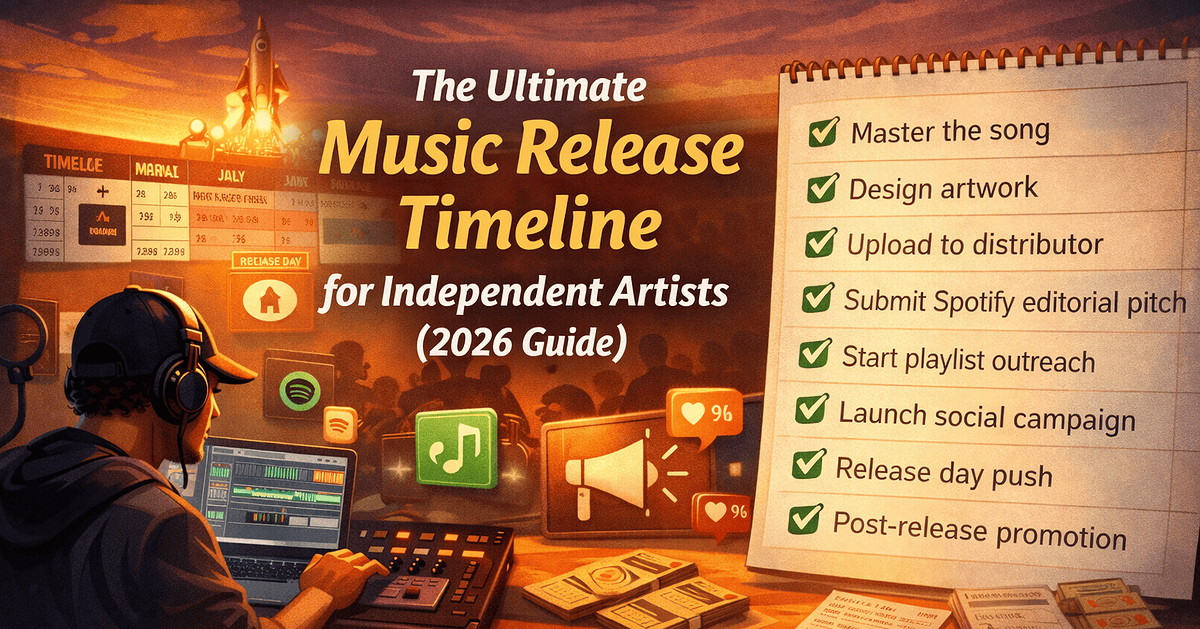
TL;DR — The 8-Week Music Release Timeline
Plan an independent music release across 8 weeks: Week 8 finalise master (–14 LUFS) and artwork; Week 6 upload to distributor for a Friday release and register ISRC/UPC; Week 4 submit Spotify editorial pitch and start independent playlist outreach; Week 3 build short-form video and tease; Week 2 launch pre-save, paid ads and email; Week 1 daily content and final push; Release day drive saves (not just streams) and engage the first 24–48 hours; Weeks +1–8 keep promoting — that’s when Discover Weekly and Release Radar pick you up. Skip any step and the algorithm skips you.
Releasing music without a plan is the single biggest mistake independent artists make. You spend months perfecting a track, upload it on a whim, post once on Instagram — and wonder why streams flatline. The truth: in 2026, with over 120,000 new tracks uploaded daily to streaming platforms (Music Business Worldwide, 2026) and global recorded music revenue at $31.7 billion with 837 million paid streaming subscribers (IFPI Global Music Report 2026), a great song alone isn’t enough.
You need a music release timeline that maximises every opportunity for playlist placement, algorithmic discovery and audience growth. This is the same 8-week release campaign timeline our team at Harment uses with independent artists worldwide. If you’d rather have it covered end-to-end, see our deeper read on how to release a song in 2026 and the complete Spotify playlist pitching guide.
Why Most Independent Music Releases Fail
The majority of independent releases underperform not because the music is bad, but because there’s no music marketing timeline behind them. Artists upload to their distributor, post once, and move on. Without a structured independent artist release plan, the algorithms never get the early signals — saves, completion, shares — they need to push your music to new listeners.
Spotify’s editorial team reviews pitches weeks in advance. Independent curators need lead time. Your audience needs multiple touchpoints before they’ll save and stream. If you’re doing everything on release day, you’ve already missed the window.
What a Professional Release Strategy Looks Like
A professional music release strategy is a structured campaign that begins weeks before your song goes live and continues for weeks after. It coordinates distribution, playlist pitching, content creation, fan engagement and paid promotion into a cohesive rollout.
When planning your release campaign timeline, Harment’s Release Aid generates a customised week-by-week checklist for your release type — single, EP or album — and pairs with the Royalties Calculator so you can model expected income before you spend on promotion.
The non-negotiables of any solid song release checklist:
- Finalised, mastered audio (–14 LUFS, –1 dBTP) and professional 3000×3000 artwork
- Early distribution to secure your Spotify for Artists pitch window
- Editorial and independent playlist outreach
- A 3–4 week content calendar for TikTok, Reels and Shorts
- A pre-save campaign and email rollout to your existing fanbase
- Post-release follow-through (weeks 2–8) to sustain algorithmic momentum
The Ideal Music Release Timeline (Overview)
Here’s the bird’s-eye view of the 8-week music release plan every independent artist should follow. Each stage is broken down in detail below.
- Week 8 — Finalise master & artwork, write press materials
- Week 6 — Upload to distributor, register ISRC/UPC, lodge with PRO
- Week 4 — Submit Spotify editorial pitch, start independent playlist outreach
- Week 3 — Produce short-form video, tease audience
- Week 2 — Launch pre-save, email blast, paid ads
- Week 1 — Final push, daily content, confirm assets
- Week 0 (Release Day) — Drive saves, go live, engage every comment
- Weeks +1 to +8 — Post-release promo, curator follow-ups, analytics review
8 Weeks Before Release
Finalise your master
Your track should be fully mixed and mastered by this point. Deliver as WAV or FLAC at 44.1 kHz / 16-bit minimum, mastered to roughly –14 LUFS integrated with peaks below –1 dBTP — the sweet spot for Spotify and Apple Music’s playback normalisation. Sanity-check the mix using Harment’s AI Song Checker for objective feedback on balance, arrangement and production quality, and the Instrumental Analyzer to confirm BPM, key and energy match your metadata.
If your track is peaking above –1 dBTP, streaming platforms will apply their own limiting on playback — and it almost always sounds worse than doing it yourself.
Design your artwork
Cover art needs to be 3000×3000 pixels, RGB, JPG or PNG. It should read as a thumbnail. Avoid text-heavy designs — simplicity and a bold focal point win on Spotify, Apple Music and TikTok previews. If your visual identity isn’t dialled in yet, work through our 9-step guide to building a strong artist brand in 2026.
Write your press materials
Prepare a 150-word artist bio, a one-paragraph description of the song, and at least one story angle. You’ll reuse these for editorial pitches, blog outreach and social copy. Need pitch emails that actually get opened? Use Harment’s DropMail to draft professional curator and blogger outreach.
6 Weeks Before Release
Upload to your distributor
Submit to your chosen distributor — DistroKid, TuneCore, CD Baby, AWAL, LANDR or similar. Set the release date for a Friday (the global new music day). Uploading 6 weeks early guarantees delivery to all platforms and lands your track in Spotify for Artists with enough lead time to pitch editorial.
Register metadata and royalties
Generate your ISRC and UPC codes, then register the work with your PRO (PRS for Music, ASCAP, BMI, SOCAN, GEMA, etc.) so you collect royalties from Day 1. Clean metadata is the #1 reason artists lose income — verify everything with Harment’s Meta Aid, and use the Royalties Calculator to model your expected payout per stream and per territory.
Get Your Track Release-Ready
Run your mix, metadata and split sheet through Harment’s free Artist Toolkit — AI Song Checker, Instrumental Analyzer, Meta Aid and Royalties Calculator. All free. No sign-up.
Explore Free Artist Tools →4 Weeks Before Release
Submit your Spotify editorial pitch
The moment your track appears in Spotify for Artists, submit your Spotify editorial pitch. This is your one chance to be considered for editorial playlists like New Music Friday, Fresh Finds and genre-specific lists. You can pitch one unreleased track at a time and the song must sit in Spotify’s system for at least 7 days before release.
A strong pitch describes mood, story and context — not just genre. Use Harment’s Pitch500 to structure a more compelling editorial submission and to access 500+ vetted independent curators in the same workflow.
How Spotify Release Radar and Discover Weekly work
Release Radar updates every Friday and pushes your new track to every follower and recent engaged listener — the bigger and warmer your audience, the wider the reach. Discover Weekly regenerates every Monday based on listener taste profiles; your song lands here when Spotify detects strong early signals: saves, completion, repeat listens and playlist adds inside the first 7 days. Front-load engagement and you trigger both.
Begin independent playlist outreach
Don’t rely solely on Spotify editorial. Independent curators collectively drive enormous discovery and their adds feed straight back into algorithmic playlists. Use Pitch500 to find curators in your genre and DropMail to send pitch emails that aren’t ignored. Never pay for placement — paid playlist services violate Spotify’s terms and can get your music removed.
3 Weeks Before Release
Create short-form content
Start producing TikToks, Reels and YouTube Shorts — behind-the-scenes clips, 15-second previews, lyric teasers, studio footage. Aim for 2–3 pieces per week until release. Cut perfectly timed hooks with Harment’s Audio Cutter. If your lyrics aren’t quite sharp yet, run them through Lyric Flow for rhyme, syllable and flow refinement before they appear in captions and lyric videos.
Tease your audience
Share snippets without revealing the whole hook. Use countdown stickers, story polls and interactive content. The goal is to make fans feel involved in the release, not marketed to. Tag collaborators and producers so their audiences see it too.
2 Weeks Before Release
Launch your pre-save campaign
Pre-saves are the streaming equivalent of pre-orders. Each one converts to a Day 1 stream and library save — the single strongest signal you can send Spotify’s algorithm. Push your pre-save link in every bio, story and email signature. Use Feature.fm, Hypeddit or your distributor’s built-in tool.
Send your email newsletter
Email outperforms social for conversion every time. Send your list a personal note, the pre-save link, and a “you’re getting this first” framing. Even a 200-person list beats 20,000 passive followers.
Consider professional promotion
If you want to amplify beyond organic reach, professional music promotion services can extend your campaign to curators, blogs and media outlets at scale — without violating any platform terms.
1 Week Before Release
Final promotional push
Increase content frequency to daily. Final countdown posts. Go live on Instagram or TikTok to talk through the song’s story. Pin the pre-save to every profile.
Prepare release-day assets
Have everything queued: smart link (Linkfire / ToneDen), Spotify URI, Apple Music URL, story templates, thank-you post, collaborator-tag posts, Spotify Canvas video, lyric video. Nothing should be improvised on Friday morning.
Release Day Strategy
Release day isn’t the finish line — it’s the start of the campaign’s most critical 48 hours. Spotify’s algorithm weighs early performance heavily when deciding whether to push your track into Discover Weekly and Radio.
Morning launch
Verify the track is live on Spotify, Apple Music, Amazon Music, YouTube Music and Tidal. Post your announcement first thing. Update bios. Pin posts. Push the smart link everywhere — including text messages to your inner circle.
Drive saves, not just streams
Explicitly ask fans to save the track to their library. A save tells the algorithm a listener wants to hear the song again — it’s the strongest engagement signal on Spotify and the clearest trigger for Discover Weekly placement.
Engage with every interaction
Reply to every comment, DM and story mention in the first 24–48 hours. This is when engagement compounds. Repost user-generated content. Go live again in the evening. The algorithm sees activity; fans see commitment.
1–2 Weeks After Release
Most artists stop promoting after release day. Mistake. The algorithm is still evaluating your track — and many algorithmic placements happen in weeks 2–4, not week 1.
- Continue content: lyric videos, acoustic versions, fan reactions, behind-the-scenes
- Follow up with curators who didn’t respond — include streaming numbers and any placements as social proof
- Monitor Spotify for Artists daily: which playlists drive streams, which cities listen, what’s your save-to-listener ratio
- Pitch blogs and online magazines for reviews and features
- Run targeted ads on Meta or TikTok using listener-city data
Long-Term Promotion (Weeks 2–12)
The best independent artists promote a release for 4–8 weeks minimum, often 12. Here’s how:
- Repurpose content across platforms (a TikTok becomes a Reel becomes a Short)
- Submit to additional independent playlists as your streaming numbers grow
- Use streaming data to fuel targeted ads in your hottest cities
- Release a remix, acoustic version or visualiser around week 6 to reignite interest
- Start teasing your next release — consistency is the real algorithmic cheat code
If a release underperforms, don’t panic — analyse and iterate. Did you give yourself enough lead time? Was the hook right? Was your pitch story-led? Treat every release as a data point. Often a song finds its audience weeks later through a viral moment or a delayed curator add. For the bigger picture, see our guide on how to promote your music without a record label in 2026.
Common Mistakes Artists Make
- ❌ Releasing without a plan. ✅ Generate a campaign in minutes with Release Aid.
- ❌ Uploading a week before release. ✅ You’ve missed the Spotify editorial pitch window — always upload 4–6 weeks ahead.
- ❌ Ignoring playlist pitching. ✅ Use Pitch500 for editorial + independent in one workflow.
- ❌ Stopping on release day. ✅ Algorithms evaluate over weeks, not hours.
- ❌ Poor or generic artwork. ✅ It’s the first thing every listener sees — invest accordingly.
- ❌ Skipping metadata. ✅ Lock it down with Meta Aid before submitting.
- ❌ Not collecting data. ✅ Spotify for Artists analytics should inform every future release.
- ❌ Releasing too infrequently. ✅ Aim for a new single every 6–8 weeks to stay in algorithmic rotation.
- ❌ Paying for fake streams or playlist placement. ✅ Violates Spotify ToS and can get tracks removed.
Plan Your Next Release the Right Way
Stop guessing and start strategising. Harment’s free Artist Toolkit gives you everything you need to release smarter — campaign planning, playlist pitching, royalty modelling, metadata, mix-checking and pitch-writing. All free. No sign-up.
Explore Free Artist Tools →The Complete Music Release Checklist
- Final mix & master (–14 LUFS, –1 dBTP)
- Mix sanity-check via AI Song Checker
- BPM / key verified via Instrumental Analyzer
- Artwork 3000×3000 px, RGB
- Clean metadata via Meta Aid
- ISRC + UPC codes assigned
- Distributor upload (6 weeks out, Friday release)
- PRO registration complete
- Royalty projection via Royalties Calculator
- Spotify editorial pitch submitted (≥ 7 days out)
- Independent playlist outreach via Pitch500
- Pitch emails written via DropMail
- 3–4 weeks of TikTok / Reels / Shorts queued
- Lyric polish via Lyric Flow
- Short-form clips cut via Audio Cutter
- Pre-save link live everywhere
- Email newsletter drafted
- Release-day smart link, Canvas, lyric video, story templates ready
- Post-release calendar booked for 4–8 weeks
Frequently Asked Questions
How long should you plan a music release?
When should you submit your song to distributors?
When should you pitch to Spotify playlists?
What is the best day to release music?
Should independent artists release singles or albums?
How important is the pre-save campaign?
What metrics matter most after release?
How long should you keep promoting after release?
How much does a music release cost in 2026?
Do I need a record label to release a song successfully?
Conclusion: Treat Every Release as a Campaign
The artists who win in 2026’s streaming landscape aren’t the most talented — they’re the ones who treat every release as a campaign, not an event. Prepare your audio properly. Choose the right distributor. Lock in a Friday release with 8 weeks of runway. Pitch editorial and independent. Run a pre-save and content rollout. Front-load release day. Optimise for save rate. Keep promoting for 4–12 weeks. Then do it all again, every 6–8 weeks.
Stop guessing. Start strategising. Your next release deserves a real music release timeline — not a hope and a hashtag.
Explore related Harment guides & tools
- How to Release a Song in 2026: The Complete Guide
- The Complete Spotify Playlist Pitching Guide
- How to Promote Your Music Without a Record Label
- How to Build a Strong Artist Brand in 2026
- The Ultimate Artist Toolbox for Independent Musicians
- Browse all free Harment Artist Tools
- Browse Harment Promotion Services
- Harment Case Studies
- Artist Showcase
- About Harment
- Contact
Ready to Release Your Next Track?
Harment’s free Artist Toolkit gives you everything you need to plan, pitch and promote a release like a pro. Release Aid, Pitch500, DropMail, Meta Aid, Royalties Calculator, AI Song Checker, Instrumental Analyzer, Audio Cutter, Lyric Flow — all free. No sign-up.
Explore Free Artist Tools →