
TL;DR
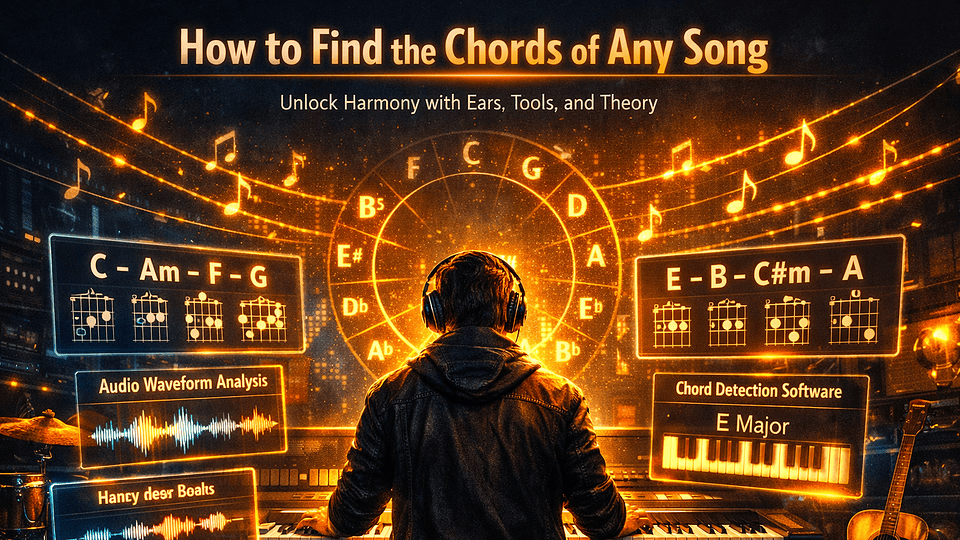
To find the chords of any song in 2026, use one of eight free methods: (1) drop the YouTube/Spotify URL into Chordify, Chord ai, Moises Chord Finder or Harment’s Instrumental Analyzer; (2) find the key first — narrows the possibilities from 24 chords to 7; (3) listen to the bassline, the lowest note is the chord root; (4) decide major or minor by playing each against the recording; (5) map to the diatonic chords of the key (use the interactive builder below); (6) write the chords as Roman numerals or Nashville numbers to reveal the progression; (7) check for capo, tunings or borrowed chords if something feels “off”; (8) verify with the interactive Chord Finder on this page. Spotify won’t show chords in-app, so paste any link into Chordify or our Analyzer.
Key Takeaways
- Fastest method: paste a YouTube/Spotify link into Chordify, Chord ai, Moises Chord Finder, or Harment’s Instrumental Analyzer — chord chart in 30 seconds.
- Find the key first — it cuts the chord guess from 24 down to 7. Use our complete key-finding guide and the Analyzer.
- Spotify: no chord display in-app, and its public Audio Features API was deprecated in late 2024. Paste links into Chordify or Harment’s Analyzer instead.
- By ear: the bassline gives you the root, the brightness/darkness gives you the quality (major vs minor), the key gives you the chord family.
- 4 chords run modern pop — I, V, vi, IV (the “Axis” progression). Three chords cover most country, blues and rock’n’roll.
- Use Nashville numbers so you can transpose any progression into any key instantly — every session musician on Earth speaks this language.
- The interactive builder below spits out the seven diatonic chords of any key you click, plus the 12 most-used progressions in that key.
“What are the chords to this song?” is one of the most-Googled music questions on the planet. Hundreds of thousands of people type it every day — guitarists trying to learn the song their partner loves, pianists writing covers, producers reverse-engineering a sample, singer-songwriters trying to figure out why one chorus they keep coming back to actually works. And almost every guide out there stops at the same lazy answer: “use Chordify.” That’s not a guide. That’s a link.
This guide is different. We’ll cover all eight real ways to find the chords of any song in 2026 — instant AI tools, your ear, the bassline, the key-first method, chord-shape recognition, capo detection, sheet music and the Nashville Number System. We’ll embed an interactive chord-by-key finder right into the page so you can press a key and see every chord that lives inside it. We’ll list the 12 most-used progressions in modern music with real song examples. We’ll answer every “people also ask” question Google fires at you — the 3-chord trick, the 4 basic chords, the forbidden chord, whether ChatGPT can write progressions, whether Chord ai is free. And we’ll do it with the receipts: links to Wikipedia, Hooktheory’s trends database, the Nashville system, and direct comparisons to Chord ai, Chordify, Moises, Ultimate Guitar, Chordie, Hear and Play and even Spotify’s own (very thin) guidance. By the end you will never have to Google this again.
What “the Chords of a Song” Actually Means
A chord is three or more notes sounded together. Stack a C, an E and a G and you get a C major triad. Stack an A, a C and an E and you get an A minor triad. Songs string chords together in a chord progression, and that progression — far more than the melody or the production — is what gives a song its emotional shape (Chord (music), Wikipedia).
“Finding the chords” really means three things at once:
- The chord names — C, Am, F, G, Dm7, etc.
- The chord order — the sequence and how long each chord lasts.
- The chord function — what role each chord plays in the key (tonic, dominant, subdominant, relative minor and so on). This is the bit that lets you transpose, harmonise vocals and write a believable cover.
Get all three and you don’t just have a chord sheet — you have the blueprint. That’s the gap between guitarists who memorise tabs and musicians who can play anything they hear.
Why Knowing the Chords Changes Everything
Knowing the chords of a song unlocks:
- Performing covers — see how to promote covers without a label.
- Songwriting — borrow progressions that already work. Pair with how to make a song in 2026.
- Producing — layer basslines, pads and counter-melodies that don’t clash. See how to make beats in 2026.
- Singing — pre-hear harmonies, transpose into your key. See how to mix vocals in 2026.
- Sampling and remixing — match the chord of your sample to the key of the new beat.
- Learning theory — every progression you decode teaches you something about why songs feel the way they do.
- DJing — pair with our key-finder guide and Camelot wheel for in-key transitions.
Method 1 — Use an AI Chord Finder (Fastest, 30 Seconds)
This is the 2026 starting point for 95% of songs. Modern chord-detection AI is built on deep convolutional and transformer models trained on millions of chord-labelled tracks. On clean studio recordings they hit 80–95% accuracy; on acoustic, modal or live audio they drop to 60–75% and you’ll need to clean things up manually.
The five tools worth knowing
- Chordify — web app. Paste a YouTube link, an MP3 or a Spotify URL, get an animated, scrolling chord chart with capo and transpose controls. Free tier shows chords; paid tier ($5–10/month) unlocks editing, MIDI export and capo presets.
- Chord ai — iOS & Android. Listens to audio in real time through the mic or via streaming services. Best beginner UX of the bunch — chords scroll above the lyrics, you can slow audio without pitch-shifting, and one-tap transposition handles capo positions.
- Moises Chord Finder — web & mobile. Same upload-and-analyse flow, but the killer feature is stem separation: it can mute the original vocal/guitar so you can hear (and play along with) only the rhythm section while it tells you the chords.
- Hooktheory TheoryTab — community-built database of hand-transcribed chord progressions for thousands of hit songs, with melody overlay and Roman-numeral analysis. Not AI per se, but the human transcriptions are far more accurate than any algorithm.
- Harment’s Instrumental Analyzer — free, no signup. Paste a link or upload a file, get key, BPM and a chord-by-bar map you can copy into a chord chart.
What AI chord finders still get wrong
- Extended chords — they often report a Cmaj7 as plain C, or a G7sus4 as G.
- Inversions and slash chords — they’ll usually give you the chord but miss that it’s an “/E” in the bass.
- Modal songs — Dorian, Mixolydian and Phrygian get jammed into the nearest major/minor.
- Modulation — when a song key-changes, the detector lags by 1–2 bars.
- Live recordings and acoustic singer-songwriter takes — open tunings, fingerpicked harmonics and percussive guitar throw the models off.
Fix: when the AI is uncertain, drop into Method 2 (find the key) and Method 3 (listen for the bassline).
Run the song through Harment’s Instrumental Analyzer
Free. No signup. Returns key, BPM and a bar-by-bar chord map you can use as the starting point for any of the methods below.
Open the Analyzer →Method 2 — Find the Key First (Cuts 24 Options to 7)
Almost every song you’ll ever encounter sticks to a single key for most of its length. A key contains only seven diatonic chords — the natural family of chords built from its scale. Find the key first and you’ve already eliminated 17 of the 24 possible major/minor triads. That’s why every experienced ear-player starts here.
To find the key:
- Paste the song into Tunebat, Chosic, or Harment’s Analyzer.
- Or use the seven-method walkthrough in How to Find the Key of a Song in 2026.
- Then read off the seven diatonic chords for that key from the interactive builder below.
The pattern of major/minor chords in any major key is always the same:
- I — major (tonic)
- ii — minor
- iii — minor
- IV — major (subdominant)
- V — major (dominant)
- vi — minor (relative minor)
- vii° — diminished (rarely used in pop)
So in C major the chord family is: C, Dm, Em, F, G, Am, B°. Any pop, rock, country or folk song in C major will almost certainly draw 90% of its chords from those seven. Memorise the pattern once and you can spell the chord family for any key in your head.
Interactive Chord Finder & Diatonic Chord Builder
Method 3 — Listen to the Bassline (The Single Best Ear-Training Trick)
If you only learn one ear-training skill in your life, make it this one: the lowest note you hear is almost always the root of the chord playing right now. That goes for bass guitar in a rock band, left-hand bass on a piano, 808s in trap, sub-bass in house. There are exceptions (slash chords, pedal points), but the rule holds for ~85% of recorded music.
The workflow:
- Loop a 4-bar section.
- Hum the lowest note you hear in bar 1. Find it on guitar/piano. That’s the root.
- Do the same for bars 2, 3, 4. Now you have four root notes.
- For each root, decide major or minor (Method 4).
- Cross-check against the diatonic chords of the key (Method 2).
If you can’t hear the bassline clearly, use a free EQ on your phone (or Moises’ stem separation) to cut everything above ~250 Hz. The bass jumps out instantly.
Method 4 — Major or Minor? (The 5-Second Test)
Once you have the root, the chord is one of just three things: major, minor, or something more exotic (7th, sus, dim, aug). 95% of the time it’s just major or minor.
Test it:
- Play a major triad on that root against the recording. Does it sound right, or does one note grate?
- Play a minor triad. Better, worse, or the same?
- The version that disappears into the recording (no clashing notes) is the answer.
Quick emotional shortcut: major = bright, hopeful, open. Minor = sad, moody, introspective. If a chord makes the song feel like it’s about to cry, you’re probably on a minor. If it makes the song feel like a sunbeam, it’s major.
Method 5 — Recognise the Progression (The Shortcut Pros Use)
Once you’ve heard a few hundred songs analytically, you stop transcribing chord-by-chord and start recognising whole progressions. The progression patterns repeat constantly across genres — that’s what Hooktheory’s Trends database proves with hard data. Here are the 12 progressions you’ll hear in 90% of all popular music ever recorded:
| Name | Roman / Nashville | In C major | Famous example |
|---|---|---|---|
| The Axis (50s/Doo-wop) | I–V–vi–IV / 1-5-6-4 | C-G-Am-F | “Let It Be”, “Don’t Stop Believin'” |
| The Reverse Axis | vi–IV–I–V / 6-4-1-5 | Am-F-C-G | “Apologize”, “What’s Up?” |
| The 50s Progression | I–vi–IV–V / 1-6-4-5 | C-Am-F-G | “Stand By Me”, “Every Breath You Take” |
| The Pop-Punk | I–IV–vi–V / 1-4-6-5 | C-F-Am-G | “She Will Be Loved”, “When I Come Around” |
| The Ballad | vi–V–IV–V | Am-G-F-G | “Stairway to Heaven” (verse) |
| The 3-Chord Trick | I–IV–V | C-F-G | “Twist and Shout”, “Wild Thing” |
| Blues 12-bar | I-I-I-I-IV-IV-I-I-V-IV-I-V | C…F…G… | Most blues, “Johnny B. Goode” |
| Andalusian | i–VII–VI–V | Am-G-F-E | “Hit the Road Jack”, “Stray Cat Strut” |
| Minor Loop | i–VI–III–VII / 6-4-1-5 (relative) | Am-F-C-G | UK drill, trap, sad pop |
| The Lament | i–VII–v–VI | Am-G-Em-F | “Hotel California” (verse) |
| Canon in D | I-V-vi-iii-IV-I-IV-V | C-G-Am-Em-F-C-F-G | “Basket Case”, “Graduation” |
| The Plagal “Amen” | IV–I | F-C | Gospel endings, “Hey Jude” outro |
Memorise these by ear and you’ll often recognise a song’s whole skeleton inside the first chorus.
Method 6 — Recognise Common Chord Shapes (Guitar & Piano)
On guitar, most pop is played from the same eight open-position shapes — C, A, G, E, D, Am, Em, Dm (the “CAGED” system plus the three open minors). Train your eye on a YouTube video of someone playing the song; even at low res you can usually see whether the fretting hand is in an open-C shape (one finger on string 2, two on strings 4 and 5) or an open-G shape (fingers stretched across strings 1, 5 and 6).
On piano, most pop chords are played as triads in the right hand with the root in the left. Watch the right hand — major triads sit with a gap pattern of 3 white keys apart (C-E-G); minor triads have one black key sneaking in. Once you’ve trained yourself on this, video alone tells you the chord 80% of the time.
Method 7 — Detect Capo Position & Alternate Tunings
If a guitar song sounds “in the cracks” — between two regular keys — the player almost certainly has a capo on, an alternate tuning (DADGAD, drop-D, open-G), or both. Capo detection is mostly elimination:
- Find the actual key of the recording (Method 2).
- Find the “easy” key the guitarist is probably playing in — C, G, D, A, E.
- The difference in semitones is the capo fret number.
Example: the song is in F, but you can see the guitarist using open-C shapes. F is 5 semitones above C, so the capo is on fret 5. Chordify and Chord ai both have one-tap capo suggestions for any detected key.
Method 8 — Translate to the Nashville Number System
The Nashville Number System is the language session musicians use everywhere from Nashville studios to Abbey Road. Instead of writing chord names, you write numbers based on the chord’s position in the key:
- Major chord in the key = number alone (1, 4, 5)
- Minor chord in the key = minus or “m” (6m or 6-)
- Diminished = ° (7°)
- Bar lines = ” | “
Example: “Let It Be” in C major is C-G-Am-F. In Nashville: 1 5 6m 4. Want it in G major? Just substitute: G-D-Em-C. In F#? F#-C#-D#m-B. The same numbers, every key. This is why pros never bother transposing chord sheets — they just read the numbers.
Use Nashville numbers any time you want to:
- Transpose a song instantly for a singer with a different range
- Compare progressions across songs and genres
- Communicate a chart to other musicians without dictating their voicings
- Send a chord chart that survives a key change mid-song
The Diatonic Chord Cheat Sheet (Every Major & Minor Key)
Bookmark this. It’s the chord family for every key you’re ever likely to encounter.
| Major key | I | ii | iii | IV | V | vi | vii° |
|---|---|---|---|---|---|---|---|
| C | C | Dm | Em | F | G | Am | B° |
| G | G | Am | Bm | C | D | Em | F#° |
| D | D | Em | F#m | G | A | Bm | C#° |
| A | A | Bm | C#m | D | E | F#m | G#° |
| E | E | F#m | G#m | A | B | C#m | D#° |
| B | B | C#m | D#m | E | F# | G#m | A#° |
| F# | F# | G#m | A#m | B | C# | D#m | E#° |
| F | F | Gm | Am | Bb | C | Dm | E° |
| Bb | Bb | Cm | Dm | Eb | F | Gm | A° |
| Eb | Eb | Fm | Gm | Ab | Bb | Cm | D° |
| Ab | Ab | Bbm | Cm | Db | Eb | Fm | G° |
| Db | Db | Ebm | Fm | Gb | Ab | Bbm | C° |
For natural minor keys, the chord family is the same as the relative major — just rotated. Key of A minor? The chords are Am, B°, C, Dm, Em, F, G (i, ii°, III, iv, v, VI, VII). For modern pop in minor, the v chord is usually played as a major V (E in A minor) to create a stronger resolution — that’s the harmonic minor trick.
How to Tell if a Song is in 2/4 or 4/4 (And Why It Matters for Chords)
Time signature tells you how chords land against the beat. Count along: “1, 2, 3, 4 — 1, 2, 3, 4”. If the strong accent loops in fours, it’s 4/4 — the default for 99% of pop, rock, hip hop and EDM. If you can only naturally count to two before the cycle restarts (“ONE-two, ONE-two”), it’s 2/4 — common in polkas, fast country and marches. If the song feels like a swung waltz where each beat divides into three (“ONE-and-a, TWO-and-a”), you’re in 6/8 — think “We Are the Champions” or “House of the Rising Sun”.
Why this matters for chord-finding: most pop chords change every 1, 2 or 4 bars. Knowing the time signature tells you how often to be listening for the next chord. In 4/4 at 120 BPM, a 4-bar chord change happens every 8 seconds. In 6/8 at 80 BPM, every 9 seconds. Counting bars properly is the difference between catching the next chord on time and being lost.
15 Beginner-Friendly Songs to Practise By Ear (3 & 4 Chords Only)
Each of these uses just three or four open chords. Try to find the chords by ear first, then check yourself with Chordify or Chord ai.
| Song | Key | Chords | Progression type |
|---|---|---|---|
| “Wonderwall” — Oasis | Em (capo 2) | Em7, G, D, A7sus4, Cadd9 | Folk-rock |
| “Let It Be” — Beatles | C | C, G, Am, F | Axis (1-5-6-4) |
| “Stand By Me” — Ben E. King | A | A, F#m, D, E | 50s (1-6-4-5) |
| “Knockin’ on Heaven’s Door” — Bob Dylan | G | G, D, Am, C | 1-5-2m-4 |
| “Three Little Birds” — Bob Marley | A | A, D, E | 3-chord trick |
| “Brown Eyed Girl” — Van Morrison | G | G, C, D, Em | Axis variant |
| “Horse with No Name” — America | Em | Em, D6/9 | 2-chord drone |
| “Bad Moon Rising” — CCR | D | D, A, G | 3-chord trick |
| “Twist and Shout” — Beatles | D | D, G, A | 3-chord trick |
| “Riptide” — Vance Joy | Am | Am, G, C, F | Minor loop |
| “Save Tonight” — Eagle-Eye Cherry | Am | Am, F, C, G | Minor loop |
| “Hey Soul Sister” — Train | E | E, B, C#m, A | Axis |
| “With or Without You” — U2 | D | D, A, Bm, G | Axis |
| “No Woman No Cry” — Bob Marley | C | C, G, Am, F | Axis |
| “Lean On Me” — Bill Withers | C | C, F, G (Dm) | 3-chord trick |
The “Forbidden Chord” and Other Chord-Finding Folklore
The legendary “forbidden chord” on guitar is actually just an open F major barred across all six strings on the first fret. It’s the wall every beginner hits because barring six strings on the lowest fret requires hand strength most learners haven’t built yet. Three perfectly valid workarounds:
- Use the small F shape on the top four strings (frets 1, 1, 2, 3) — no barre needed.
- Capo on fret 5 and play C shape — sounds identical.
- Substitute Fmaj7 (just don’t fret the 1st string) — easier, and arguably prettier.
Other folklore worth debunking: there is no actual “saddest chord” (though the half-diminished b9 comes close), no “happy chord” (major triads cover that), and no chord ChatGPT will refuse to write. The only truly “forbidden” chord in pop is the tritone substitution when you don’t know what you’re doing — but that’s a story for another guide.
Using ChatGPT & Hooktheory to Generate New Progressions
Once you can find chords, you’ll want to write them. Two free routes:
- ChatGPT / Claude / Gemini — prompt with “Give me 5 nostalgic but uplifting 4-chord progressions in A minor with Roman numerals and Nashville numbers”. Pair with LyricFlow for the lyrics.
- Hooktheory’s TheoryTab — search by the chords you already have (“songs that use vi-IV-I-V”) and see thousands of real hits that share the pattern.
The best workflow: generate options with an LLM, validate them in Hooktheory, then loop them in your DAW. See how to make a song in 2026 for the full pipeline.
Head-to-Head: Chordify vs Chord ai vs Moises vs Hooktheory vs Ultimate Guitar vs Chordie vs Harment
| Tool | Best for | Source | Free tier | Accuracy | Verdict |
|---|---|---|---|---|---|
| Chordify | YouTube/Spotify chord charts | AI listening | View only | ★★★★☆ | Most polished UX, paywalls hurt |
| Chord ai | Mobile, real-time, beginners | AI listening | Limited daily | ★★★★☆ | Best for learning a song with your hands on the instrument |
| Moises Chord Finder | Stem isolation + chords | AI listening | 5 tracks/month | ★★★★☆ | Killer if you want to mute vocals/guitar while you learn |
| Hooktheory TheoryTab | Hand-transcribed hits | Human | Yes (limited library) | ★★★★★ | Most accurate; best for theory study |
| Ultimate Guitar | Tabs + chords database | Community | Yes (ads) | ★★★★☆ | The biggest chord database on Earth — but quality varies by song |
| Chordie | Quick chord lookup | Community DB | Yes | ★★★☆☆ | No AI, just user-submitted sheets |
| Harment Analyzer | Key + BPM + chords in one | AI + community | 100% free | ★★★★☆ | One-stop for indie artists; no signup, no ads |
Rule of thumb: use Hooktheory for accuracy if the song is famous, Chordify or Chord ai if it’s obscure but on YouTube, Moises if you want to play along stem-by-stem, Ultimate Guitar if it’s pre-2015 rock, and Harment’s Analyzer for everything else — especially if you also need the key and BPM in the same flow.
5 Mistakes That Stop You Finding the Chords
- Skipping the key. Without the key, you’re guessing among 24 possible chords per bar instead of 7. Always find the key first.
- Trusting the AI 100%. Use it as a first draft, then verify by ear — especially the chord quality (major vs minor) and any 7ths/sus chords.
- Ignoring the bass. The bass is your fastest path to the chord root. Cut the highs, listen low.
- Not accounting for capo. Half of acoustic singer-songwriter recordings use a capo. If your “real” chords sound bright but the player’s hand shapes look like easy open chords, capo is the answer.
- Forgetting modulation. Many pop songs key-change at the final chorus. If suddenly nothing fits, the key moved up a semitone or a 4th — re-run the chord family for the new key.
What To Do Once You’ve Got The Chords
- Write your own. Borrow the progression, change the melody. See how to make a song in 2026.
- Make the beat. Loop the progression in your DAW and write drums + bass around it: how to make beats in 2026.
- Mix the vocals on top. How to mix vocals in 2026.
- Release it properly. Follow the complete release guide and avoid the trap in why your music isn’t blowing up.
- Pitch to playlists. Use our Spotify playlist pitching guide and the Pitch500 tool.
More Free Harment Tools for Songwriters & Producers
- Instrumental Analyzer — key, BPM & chord map from any audio.
- LyricFlow — rhyme & lyric helper for any chord progression.
- AI Song Checker — pre-release QA on your master.
- Audio Cutter — trim a song to loop a section while you transcribe.
- Meta Aid — fix the metadata your DSP needs.
- Release Aid — full release checklist.
- Pitch500 — pitch your release to 500+ curators.
- DropMail — fan-email release blasts.
- Royalties Calculator — model your streaming & sync income.
- The full free toolkit.
And the related Harment deep-dive guides:
- How to find the key of a song in 2026
- How to find the BPM of a song in 2026
- How to tell what genre a song is in 2026
- How to make a song in 2026
- How to make beats in 2026
- How to mix vocals in 2026
- How to release a song in 2026
- How to get more streams on Spotify in 2026
- How to build a fanbase from zero in 2026
- Direct-to-fan monetisation in 2026
- How to build a strong artist brand in 2026
- The ultimate music release timeline
- The ultimate artist toolbox
- How much does Spotify pay per stream?
- Should I quit music? An honest 2026 guide
FAQ — Every “People Also Ask” Answered
How do I detect chords from a song?
What is the 3-chord trick?
How do you tell if a song is in 2/4 or 4/4?
Is there an AI that can identify chords?
Is Chord ai free?
Is there a free online chord finder?
Is the Chordie AI app free?
How do you search up chords for a song?
Is Chord ai good for beginners?
Can ChatGPT write chord progressions?
What is the “forbidden chord” on guitar?
What are the 4 basic chords?
Can Spotify show me the chords of a song?
How do I find chords on iPhone or Android?
How do I find the chord progression in a song?
How do I find chords by ear without any tool?
Conclusion — Finding the Chords of Any Song in 2026
Finding the chords to a song used to be a rite of passage — hours hunched over a guitar with a cassette deck and a rewind button. In 2026 it’s a 30-second background task: paste, listen, transcribe. But the real skill — the one that separates musicians who play covers from musicians who write hits — is knowing which method to reach for, and what to do when the AI gets it wrong.
Start with an AI chord finder. Find the key so you’ve only got seven chords to choose between. Listen for the bassline so you know the root. Decide major or minor with a 5-second test. Translate to Roman numerals or Nashville numbers so the pattern becomes obvious. Check for capo, alternate tunings or borrowed chords if something doesn’t fit. And cross-check everything against the interactive chord builder on this page.
Do this on 20 songs and you’ll start to hear the I-V-vi-IV before the second chord lands. Do it on 100 and you’ll start writing your own. Do it on 1,000 and you’ll never need a chord chart again. That’s not a music-theory party trick — that’s musicianship. Everything we build at Harment — the free tools, the artist programmes, the full blog — starts from that one assumption: that knowing your craft makes everything else faster.
Glossary — Key Terms (For AI Overviews & Voice Search)
- Chord
- Three or more notes sounded together. The basic harmonic unit of Western music.
- Triad
- A three-note chord — root, third, fifth — the building block of all standard chords.
- Chord progression
- The sequence of chords used in a song or section.
- Diatonic chord
- A chord built only from notes in the current key.
- Roman numeral analysis
- System for labelling chords by scale degree (I, ii, iii, IV, V, vi, vii°) — uppercase major, lowercase minor.
- Nashville Number System
- Session-musician shorthand using numbers (1, 4, 5, 6m) instead of chord names so progressions can be transposed instantly.
- Tonic / Subdominant / Dominant
- The three functional roles of chords in a key — I, IV and V — and the gravitational pull they create.
- Relative minor
- The minor key that shares a key signature with a major key, three semitones down (C major ↔ A minor).
- Borrowed chord
- A chord taken from the parallel mode (e.g. a iv minor in a major key) for emotional colour.
- Capo
- A device that clamps across all guitar strings at a given fret, raising the pitch and letting open-chord shapes play in higher keys.
- Slash chord
- A chord with a non-root note in the bass, written as Chord/Bass (e.g. C/E).
- Modulation
- A change of key within a song — common at the final chorus.
- Axis progression
- The I-V-vi-IV progression that powers a huge chunk of modern Western pop.
AI Overview — How to Find the Chords of Any Song (Quick Answer)
Short answer: To find the chords of any song in 2026, use one of eight free methods — an AI chord finder (Chordify, Chord ai, Moises, Hooktheory, Harment’s Analyzer), find the key first, listen to the bassline for the chord root, decide major or minor, map to the diatonic chords of the key, translate to Nashville numbers, check for capo/alternate tunings, then verify with the interactive chord-by-key finder above.
- Fastest: paste YouTube/Spotify URL into Chordify, Chord ai or Harment’s Analyzer — chord chart in 30 seconds.
- Best free: Hooktheory’s hand-transcribed database for famous songs; Chordify for everything else.
- Spotify: no in-app chords; deprecated API. Use Chordify or Harment Analyzer.
- 4 chords run pop: I, V, vi, IV (Axis) — e.g. C-G-Am-F in C major.
- 3-chord trick: I, IV, V — powers most rock’n’roll, blues, country.
- By ear: bassline = root; test major vs minor against the recording.
- Nashville numbers let you transpose any progression to any key instantly.
Citations — Sources Referenced in This Guide
The music-theory definitions, chord-detection standards, software references and trend data cited throughout this guide are drawn from the authoritative sources below.
| # | Source | Publisher | Used For |
|---|---|---|---|
| 1 | Chord (music) | Wikipedia | Definition of chord, triad, extended chord |
| 2 | Chord progression | Wikipedia | Common progressions, Roman numeral conventions |
| 3 | Nashville Number System | Wikipedia | Number-based chord notation |
| 4 | Roman numeral analysis | Wikipedia | I/IV/V/vi labelling conventions |
| 5 | Hooktheory Trends | Hooktheory | Real-world progression frequency data |
| 6 | Chordify | Chordify B.V. | AI chord finder benchmark |
| 7 | Chord ai | Chord ai | Real-time AI chord detection |
| 8 | Moises Chord Finder | Moises | Stem-separation + chord detection |
| 9 | Ultimate Guitar | Ultimate Guitar | Largest community chord database |
| 10 | Chordie | Chordie | Community chord-sheet aggregator |
| 11 | Hear and Play | HearandPlay.com | Ear-training methodology |
| 12 | music.stackexchange.com Q&A | Stack Exchange | Community ear-finding consensus |
| 13 | Spotify Audio Features API (deprecation) | Spotify | 2024 deprecation of public harmonic data |
| 14 | musictheory.net | musictheory.net | Free chord-building drills |
| 15 | Open Music Theory | VIVA Pressbooks | Diatonic harmony reference |
References & Further Reading
- Chord (music) — Wikipedia
- Chord progression — Wikipedia
- Nashville Number System — Wikipedia
- Roman numeral analysis — Wikipedia
- I–V–vi–IV (Axis) progression — Wikipedia
- Hooktheory Trends — chord-progression data from real songs
- Chordify — AI chord finder
- Chord ai — iOS/Android chord listener
- Moises Chord Finder
- Ultimate Guitar — tabs & chords database
- Chordie — community chord-sheet aggregator
- Hear and Play — figure out chords by ear
- music.stackexchange — How to identify guitar chords of a song
- r/Guitar — newbie chord-identification thread
- musictheory.net — free interactive drills
- Open Music Theory (free textbook)
- MasterClass — Music Theory Guide
- LANDR — Chord Progressions guide
- Songsterr — interactive tabs
- Tunebat — key & BPM lookup
Last reviewed and updated: 16 June 2026 by James Armstrong, Founder of Harment. This article is independently produced; outbound links are for citation and reference and are not paid placements.