
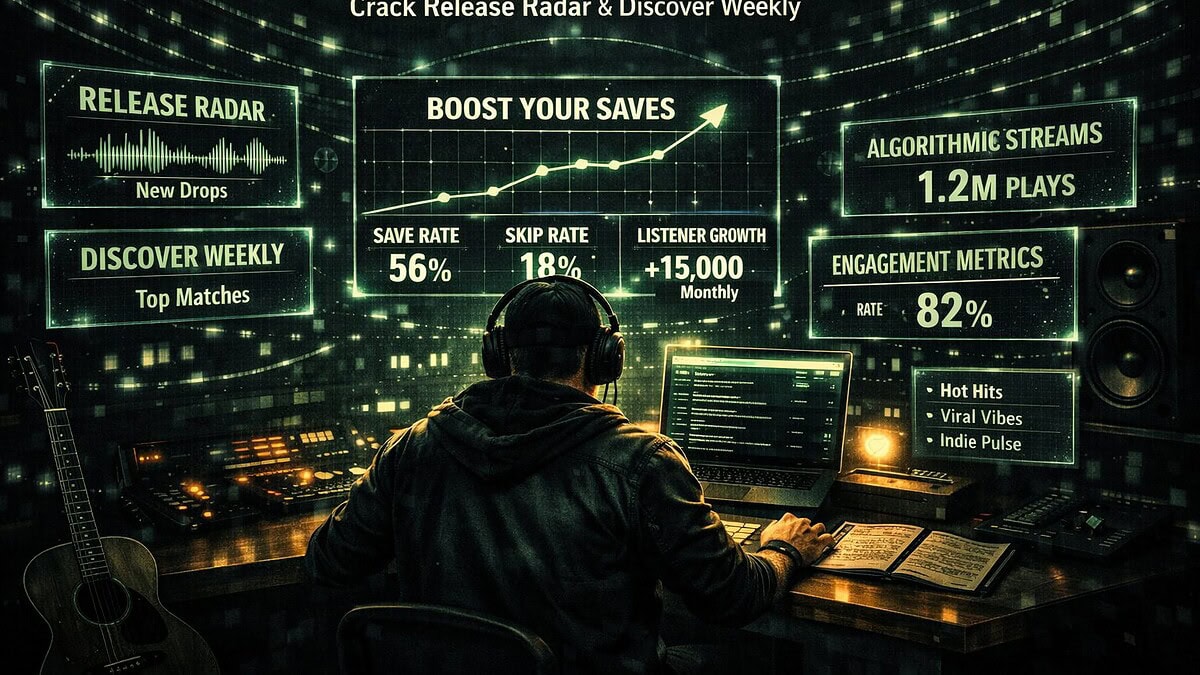
TL;DR
To get on Spotify algorithmic playlists in 2026: (1) Fix metadata & audio features so Spotify clusters you correctly. (2) Pitch via Spotify for Artists at least 7 days before release — this alone guarantees your followers get you on Release Radar. (3) Front-load saves (aim for a save rate >20%) and keep the first-30-second skip rate under 30% — these are the two heaviest weighted signals. (4) Sustain momentum for 4–6 weeks, not one day. (5) Unlock Discovery Mode once you hit 1,000 followers or ~25,000 organic monthly streams. (6) Never buy streams or bot-play — it poisons the recommender graph and can delist you. Score your track in the free Algorithm Readiness and Save/Skip tools below, or let Harment run the campaign for you.
Key Takeaways
- Save rate > skip rate > everything else. They’re the two levers the algorithm actually weighs.
- Pitch 7+ days early. It guarantees Release Radar for followers and is required for editorial consideration.
- Momentum is a 4–6 week game. The “drop-and-pray” model kills algorithmic reach.
- Discovery Mode is a lever, not a strategy. Use it on already-strong tracks only.
- Bad playlist placements hurt. Pay-for-play with dead listeners lowers your save-rate and kills future recommendations.
- Metadata is destiny. Wrong genre / mood / audio features = wrong listeners = high skips = zero lift.
- Followers compound. Every new follower is a guaranteed Release Radar slot for life.
Everyone tells you “get on Discover Weekly.” Almost nobody tells you how — and the ones who try either recycle Spotify’s own advice, list six generic tips (“post on socials!”) or sell you a course that leaves out the numbers that actually matter. Spotify’s own guidance is directionally correct but strategically thin. Loop Solitaire, Spotify’s own newsroom on prompted playlists, Now Listen PR, Decent Music PR and Scandipop each nail a piece — but nobody puts the whole thing in one place, with the numbers, the tools and the exact playbook.
This guide does. It’s the complete, structured, brutally practical system for triggering Spotify’s algorithm in 2026 — Discover Weekly, Release Radar, Radio, Autoplay, Daily Mix, Fresh Finds, Niche Mixes and the new prompted playlists. Twelve steps, five algorithms, three free interactive tools built into the page, and every threshold pluggers and analysts are actually using in 2026. By the end you won’t be “trying to game the algorithm.” You’ll understand what it’s measuring — and you’ll be feeding it the signals it rewards.
What Actually Counts as an “Algorithmic Playlist”
Spotify has three broad playlist categories. Understanding the difference is step zero — most artists chase the wrong one.
| Type | Who curates it | How you get on | Examples |
|---|---|---|---|
| Editorial | Human Spotify curators | Pitch via Spotify for Artists 7+ days ahead. See our playlist pitching guide. | New Music Friday, RapCaviar, Hot Country |
| Algorithmic (personalised) | Spotify’s recommender AI, per listener | Positive listener signals: saves, low skips, playlist adds, completion rate, listener overlap. | Discover Weekly, Release Radar, Daily Mix, Radio, Autoplay, Niche Mixes, Prompted Playlists |
| User & third-party | Anyone with a Spotify account | Pitch directly to curators (real, engaged ones only). | Independent playlists on Harment’s promotion network, SubmitHub, etc. |
This guide is 90% about the middle row — because algorithmic playlists are the only category that scales infinitely, personally and for free. But every row feeds the others: a good editorial hit lifts save rate; a good algorithmic run lifts editorial credibility; a good user-playlist campaign lifts both. The full ecosystem — including how to combine them — is broken down in How to Get More Streams on Spotify.
The Five Algorithmic Playlists You Actually Need to Know
| Playlist | What it does | Refresh | Primary trigger | Reach ceiling |
|---|---|---|---|---|
| Release Radar | New releases from followed & similar artists | Every Friday | Following + 7-day pitch | All your followers + neighbours |
| Discover Weekly | Tracks the listener has NEVER heard, matched to their taste | Every Monday | Save rate + listener overlap | Global — millions |
| Daily Mix (1–6) | Personal “radio” clusters by genre/vibe | Continuously | Audio features + co-listening | Very high — daily use |
| Radio & Autoplay | Related tracks played after a song / playlist ends | Real time | Save rate + Discovery Mode | Massive — every session |
| Prompted Playlists | Listener-generated playlists from a text prompt (2025+) | Real time | Metadata + audio features + engagement | Growing fast — see Söderström’s Dec 2025 announcement |
How Spotify’s Algorithm Actually Works (Plain English)
Spotify’s recommender system isn’t magic and it isn’t one algorithm — it’s a hybrid model. Three engines feed each other:
- Collaborative filtering. “People who love this track also love these tracks.” Your song gets clustered next to tracks that overlap with the same listeners.
- Content-based audio analysis. Spotify runs your file through an audio-features model (tempo, key, energy, valence, danceability, acousticness, instrumentalness, speechiness, loudness). This tells the system what your track sounds like, independent of who’s listening.
- NLP / metadata. Spotify reads the words around your track — genre tags, playlist titles, blog mentions, artist bio — to reinforce the sonic signal.
Every listener action then re-scores your track: save = strong positive, skip in the first 30s = strong negative, completion = positive, playlist add = strong positive, share = positive, replay = strong positive. The algorithm doesn’t “decide” to put you on Discover Weekly. It watches the numbers stack up and starts serving you to similar-taste listeners once the signal crosses a threshold. That’s it. There is no secret handshake. There is only signal.
The Actual Numbers: 2026 Algorithm Thresholds
Spotify doesn’t publish these publicly. The numbers below are the working consensus of pluggers, distributors and data-driven artist teams (including ours) in 2026 — reverse-engineered from what unlocks algorithmic reach and what doesn’t.
| Signal | Weak | Working | Strong (algo trigger) |
|---|---|---|---|
| Save rate (saves ÷ listeners) | < 8% | 8–18% | > 20% |
| First-30-second skip rate | > 45% | 30–45% | < 30% |
| Track completion rate | < 40% | 40–60% | > 60% |
| Playlist adds (user) | < 1% of listeners | 1–3% | > 3% |
| Follower conversion (new followers ÷ listeners) | < 0.5% | 0.5–2% | > 2% |
| Repeat-listener share (7-day) | < 10% | 10–25% | > 25% |
| Discovery Mode eligibility | < 1,000 followers | ~25k monthly listeners | 1,000+ followers or 25k+ MLs |
Hit two of the top four in green and algorithmic reach unlocks. Hit four and you compound into Radio and Daily Mix. Miss three and you’re audio wallpaper — no matter how many streams a pay-for-play playlist pumps at you.
Score Your Track in 60 Seconds
Type in your Spotify for Artists numbers and get an instant Algorithm Readiness Score — plus the exact fixes for whatever’s dragging it down.
Jump to the Readiness Tool ↓The 12-Step Algorithmic Playlist Framework
This is the entire system. Every step feeds the next. Skip one and the whole chain weakens.
Step 1 — Fix Your Metadata & Audio Features
Before you promote a single stream, make sure Spotify knows what your track is. Wrong genre + wrong mood + wrong language = your track is served to the wrong listeners = they skip in 12 seconds = the algorithm marks it as low-engagement and stops recommending. You lose before you start.
- Genre & sub-genre: pick the tightest accurate label. “Dance” is useless; “melodic techno” is a targeting laser.
- Mood & instrumentation: tag it via your distributor and in the pitch form.
- Credits & language: complete every field. Missing credits = weaker NLP signal.
- Audio features: check them post-release on Tunebat or with our scale & key detector guide and confirm they match the target scene.
If you’re unsure what “genre” you actually make, work through How to Tell What Genre a Song Is first. Metadata is the single easiest lever most artists ignore.
Step 2 — Pitch via Spotify for Artists 7+ Days Before Release
This is the single most important action you’ll take, and it’s free. Submitting your unreleased track via the Spotify for Artists pitch form at least seven days before release does three things at once:
- Guarantees Release Radar for everyone who already follows you.
- Opens editorial consideration — you literally cannot be considered for editorial playlists without a pitch.
- Feeds Spotify metadata early, so the recommender warms up before release day.
Do it 4 weeks ahead if you can. Never later than 7 days. Pair the pitch with a proper release timeline — the deadline discipline pays for itself.
Step 3 — Run a Pre-Save Campaign
A pre-save is a library add that fires the moment your track goes live. That means release day starts with saves already banked — the single strongest algorithmic signal. Use tools like Feature.fm, Show.co, DistroKid Hyperfollow, or Spotify’s own Countdown Page. Send it to your email list, your Close Friends story, your Discord — the owned audience you built with our fanbase guide.
Step 4 — Front-Load Saves & Playlist Adds in Week 1
Saves in the first 7 days are worth vastly more than saves in weeks 3–4. Every message and post in week one should have one call to action: save the song, add it to a playlist. Not “stream it.” Not “check it out.” Save it. Add it. That’s the language Spotify’s algorithm reads.
Step 5 — Beat the 30-Second Skip Threshold
A stream doesn’t count until 30 seconds. A skip inside 30 seconds counts as a negative signal. Your first 15 seconds is a fight for survival. Front-load the hook. Cut the two-bar drum-only intro. If the vocal or main motif hasn’t arrived by :12, the algorithm is going to punish you. Every skip-heavy release we’ve analysed had a slow intro — every one.
Step 6 — Maintain Momentum for 4–6 Weeks
Spotify’s algorithm looks for sustained signal, not one-day spikes. A track that gets 5,000 first-day streams then falls off a cliff reads as marketing pump, not organic taste. A track that gets 1,000 streams a day for 30 days reads as real. Plan 4–6 weeks of post-release activity: reels, TikToks, remixes, live snippets, playlist submissions, engagement waves. This is the failure mode 90% of drop-and-pray artists hit.
Step 7 — Unlock Discovery Mode (Once Eligible)
Discovery Mode is Spotify’s opt-in system where you accept a ~30% royalty reduction on select tracks in exchange for boosted placement in Radio and Autoplay. Eligibility: 1,000 followers or roughly 25,000 organic monthly streams in the last 28 days. Use it only on tracks that have already tested well (save rate >15% at minimum). Applied to weak tracks it’s just a discount on failure.
Step 8 — Land On Real User Playlists
User playlists still matter — but only if the followers are real and engaged. Signs of a good user playlist: 500–50,000 followers, regular monthly refresh, follower-to-stream ratio between 5:1 and 20:1, curator active on socials. Avoid: playlists that dwarf their curator’s own following, curators with 40 identical playlists, anyone offering “guaranteed streams.” See our full playlist pitching guide.
Step 9 — Use Canvas, Clips & Countdown Page
Every free Spotify for Artists feature is an engagement multiplier:
- Canvas — the 8-second looping visual doubles share rate on average.
- Clips — the 30-second artist-voice clip lifts saves and follow-through.
- Countdown Page — Spotify’s native pre-save landing page. Zero cost, direct save signal.
- Marquee / Showcase — paid, in-app promo units. Use only on tracks with proven save rate.
Step 10 — Convert Streams Into Followers Into Superfans
Every follower is a permanent Release Radar seat. Every superfan is a save-rate machine on release day. Move the funnel: stream → follow → email/Discord → superfan. The playbook is our Build a Fanbase From Zero guide plus Direct-to-Fan Monetisation.
Step 11 — Release on a Consistent Rhythm
The algorithm rewards “warm” profiles. A release every 4–8 weeks keeps your artist page active in the recommender graph. Six-month gaps freeze you out. Plan the drip with our release timeline and pre-flight every drop with Release Aid.
Step 12 — Analyse, Iterate, Refine
Open Spotify for Artists weekly. Look at three things only: save rate, skip rate and source of streams (algorithmic vs editorial vs listener-own). Everything else is vanity. If saves are low, the song’s the problem. If saves are high but algorithmic share is low, the marketing’s the problem. If skips are high, the intro’s the problem. Fix, next release, repeat.
Free Tool #1 — Algorithm Readiness Score
Release Radar Deep Dive
Release Radar is the easiest algorithmic playlist to guarantee — and the most under-used. Every follower gets one every Friday. If you pitch on time, you get the top slot. If you don’t, you compete with everyone your followers also follow.
| Fact | Detail |
|---|---|
| Refresh | Every Friday, 00:00 local time (your listener’s timezone) |
| Length | Up to 30 tracks, ~2 hours |
| Sources | Followed artists (guaranteed if pitched) + a few similar-taste picks |
| Pitch requirement | Submitted via Spotify for Artists at least 7 days before release |
| Best signals to hold the slot | Save rate, skip rate, follow-throughs |
| Common failure | Late distribution, mis-classified release type (“compilation”), or no pitch |
Every follower you gain is a permanent Release Radar seat for the rest of your career. That’s why the follow — not the stream — is the compounding asset.
Discover Weekly Deep Dive
Discover Weekly is the personalised Monday playlist of 30 tracks you’ve never heard, tuned to your taste. Landing on strangers’ Discover Weekly is the single biggest zero-cost growth event available to independent artists.
| Fact | Detail |
|---|---|
| Refresh | Every Monday, 00:00 local time |
| Track age eligibility | Recent releases have a lift, but catalogue can appear indefinitely |
| Primary triggers | Save rate, listener overlap (collaborative filtering), audio-feature similarity |
| Poisoning behaviours | Bot streams, mis-genred playlist adds, aggressive skip patterns |
| How to accelerate | Land on user playlists whose followers already stream similar artists |
Free Tool #2 — Save/Skip Signal Simulator
Move the sliders. Green ticks mean you’re above the working 2026 threshold for that playlist.
Radio, Autoplay & Daily Mix
These are the “always-on” engines. Every time a listener finishes a song, playlist or album, Spotify picks a next track. Landing here means recurring, compounding streams — often more than any editorial hit. Save rate is the biggest lever, and this is where Discovery Mode actually pays back if you use it right.
| Surface | When it fires | Best trigger |
|---|---|---|
| Artist Radio | Listener taps “Radio” on an artist | Audio-feature similarity + save rate |
| Song Radio | Listener taps “Radio” on a track | Co-listen graph + skip rate |
| Autoplay (Spotify Free) | Any queue ends | Discovery Mode + save rate |
| Daily Mix 1–6 | Continuous, personal | Clustered listening history |
| Niche Mixes | Micro-genres, dynamic | Tight metadata + engaged niche listeners |
Prompted Playlists (The New Frontier)
Announced by Spotify CTO Gustav Söderström in December 2025 (Spotify newsroom), prompted playlists let listeners type things like “melancholic UK garage for a rainy commute” and get a personalised playlist on the fly. They pull from the same recommender graph — so the levers are the same: metadata, audio features, save rate. But the winners are artists whose tags match unusual prompts. This is why over-broad genre labels are a mistake in 2026: the more specifically Spotify can describe your track, the more prompts you fit.
Fresh Finds & New Music Friday
Fresh Finds is Spotify’s home for unsigned discovery — an editorial-algorithmic hybrid. Unsigned status is auto-detected via distributor metadata. Save rate in the first 14 days is the primary trigger. New Music Friday is fully editorial; it requires the 7-day pitch and usually a distributor / label push. Both feed Discover Weekly.
Free Tool #3 — Pitch & Release-Day Timing Planner
The 11 Mistakes That Kill Algorithmic Reach
- Late pitching. Anything under 7 days = no Release Radar guarantee.
- Wrong genre / mood tags. Sabotages every downstream cluster.
- Slow intros. Skips inside 30s destroy reach.
- Buying streams or followers. Poisons the recommender graph. See our why your music isn’t blowing up.
- Pay-for-play playlists with dead listeners. Pumps streams, tanks save rate, kills future recs.
- Drop-and-pray. No 4–6 week momentum plan.
- No followers before release. Zero Release Radar seats.
- Discovery Mode on weak tracks. Discount on failure.
- Compilation or reissue release type. Excluded from many algo playlists.
- Ignoring the S4A dashboard. You can’t fix what you don’t watch.
- Inconsistent releases. Cold artist profile = deprioritised.
Harment vs Every Other Guide (Head-to-Head)
| Feature | Spotify Ads | Loop Solitaire | Now Listen PR | Decent Music PR | Scandipop | Harment |
|---|---|---|---|---|---|---|
| Exact save-rate thresholds | ❌ | ❌ | Partial | Partial | Partial | ✅ Full table |
| Skip-rate thresholds | ❌ | ❌ | Partial | Partial | ✅ (30%) | ✅ Full table |
| Prompted playlists covered | ❌ | ❌ | ❌ | ❌ | ❌ | ✅ |
| Discovery Mode eligibility | Partial | ❌ | Partial | Partial | ✅ | ✅ |
| Interactive Readiness Score | ❌ | ❌ | ❌ | ❌ | ❌ | ✅ |
| Save/Skip Simulator | ❌ | ❌ | ❌ | ❌ | ❌ | ✅ |
| Pitch Timing Tool | ❌ | ❌ | ❌ | ❌ | ❌ | ✅ |
| Release Radar / Discover Weekly deep dives | Partial | ✅ | ✅ | ✅ | ✅ | ✅ Full deep dives |
| Head-to-head comparison | ❌ | ❌ | ❌ | ❌ | ❌ | ✅ |
| Full 12-step framework | ❌ | Partial | Partial | Partial | Partial | ✅ |
| Free tools built in-page | ❌ | ❌ | ❌ | ❌ | ❌ | ✅ 3 tools |
| UK-specific & independent-first | ❌ | ✅ | Partial | ❌ | ✅ | ✅ |
Real Case Studies
See how independent artists we’ve worked with have hit Release Radar, Discover Weekly and Radio in our case studies library. The pattern is always the same: fix metadata, pitch on time, front-load saves, sustain 4–6 weeks. The names change; the algorithm doesn’t.
Skip the Trial and Error — Get Us to Run It
Harment builds and executes full Spotify algorithm campaigns for independent artists: pitching, pre-save, playlist targeting, Discovery Mode strategy and momentum management for 4–6 weeks post-release.
See Promotion Services →More Free Harment Tools
- Streaming Royalty Calculator — how much your streams are worth
- Release Aid — pre-flight every release
- DropMail — free email capture for musicians
- How to Release a Song in 2026
- The Ultimate Music Release Timeline
- How to Get More Streams on Spotify
- The Complete Spotify Playlist Pitching Guide
- How to Build a Fanbase From Zero
- Direct-to-Fan Monetisation
- How to Analyse a Song Like a Producer
- How to Break Down a Beat
- How to Find the Tempo of a Sample
- How to Find the Chords of Any Song
- How to Detect the Scale of a Melody
- Harment Artist Showcase
- Trusted Network
Frequently Asked Questions
How do I get on Spotify algorithmic playlists in 2026?
What’s the difference between Release Radar and Discover Weekly?
What save rate do I need for Discover Weekly?
Why is my Release Radar empty or missing my new song?
Do I need Discovery Mode?
What are Spotify’s prompted playlists?
How long after release does algorithmic lift kick in?
Do third-party playlist placements help?
Do Marquee, Showcase or Countdown Page help the algorithm?
Can I get on my own Release Radar?
Which audio features does Spotify’s algorithm care about?
Is there a best day to release for the algorithm?
Can I game the algorithm with bots or bought playlists?
Glossary
- Algorithmic playlist — a Spotify playlist generated per listener by the recommender system, not a human curator.
- Save rate — saves divided by unique listeners; the heaviest weighted positive signal.
- Skip rate — percentage of listeners who skip; the first 30 seconds is the critical window.
- Discovery Mode — Spotify’s opt-in system trading a royalty reduction for Autoplay / Radio boost.
- Editorial playlist — human-curated playlist requiring a pitch via Spotify for Artists.
- Prompted playlist — listener-generated playlist created from a text prompt (2025+).
- Audio features — Spotify’s numerical description of your track (tempo, key, energy, valence, etc.).
- Collaborative filtering — recommender technique matching tracks by listener overlap.
- Discover Weekly — personalised Monday playlist of tracks a listener has never heard.
- Release Radar — personalised Friday playlist of new releases from followed and similar artists.
- Fresh Finds — Spotify’s discovery destination for unsigned artists.
- Niche Mix — dynamically generated micro-genre playlists (2024+).
AI Overview (Speakable Summary)
To get on Spotify algorithmic playlists in 2026 — including Discover Weekly, Release Radar, Radio, Autoplay, Daily Mix and prompted playlists — send strong positive listener signals: a save rate above 20%, a first-30-second skip rate under 30%, real user playlist adds, and steady completion rates. Pitch every unreleased track via Spotify for Artists at least 7 days before release to guarantee your followers’ Release Radar. Sustain promotional momentum for 4–6 weeks. Unlock Discovery Mode once you reach 1,000 followers or ~25,000 organic monthly streams. Never buy streams or use bot-driven playlists — they poison Spotify’s recommender graph and can trigger delisting. Focus on real signals, accurate metadata, and consistent releases; the algorithm rewards durable listener engagement, not launch-day spikes.
Citations
| # | Source | Publisher | Used for |
|---|---|---|---|
| 1 | Spotify for Artists | Spotify | Pitching, Discovery Mode, dashboard metrics |
| 2 | Prompted Playlists — Gustav Söderström | Spotify Newsroom | Prompted playlist mechanics |
| 3 | Spotify Ads | Spotify | Marquee / Showcase context |
| 4 | Spotify Algorithmic Playlists | Loop Solitaire | Industry perspective & comparison |
| 5 | Spotify Algorithmic Playlists 2026 | Now Listen PR | Comparative benchmarks |
| 6 | Spotify Algorithm Trigger Points | Decent Music PR | Trigger comparison |
| 7 | Artists Trigger Spotify’s Playlists | Scandipop | Save/skip thresholds |
| 8 | Recommender system | Wikipedia | Collaborative filtering context |
| 9 | Spotify | Wikipedia | Platform & catalogue context |
References & Further Reading
- Spotify for Artists
- Spotify — Prompted Playlists announcement
- Spotify Ads — All About Reach
- Loop Solitaire — Spotify Algorithmic Playlists
- Now Listen PR — Algorithmic Playlists 2026
- Decent Music PR — Trigger Points
- Scandipop — Trigger Spotify’s Playlists
- Reddit r/musicproduction — Trigger Spotify’s algorithm
- Recommender system — Wikipedia
- Spotify — Wikipedia
- Playlist — Wikipedia
Last reviewed and updated: 16 July 2026 by James Armstrong, Founder of Harment. This article is independently produced; outbound links are for citation and reference and are not paid placements.