
TL;DR
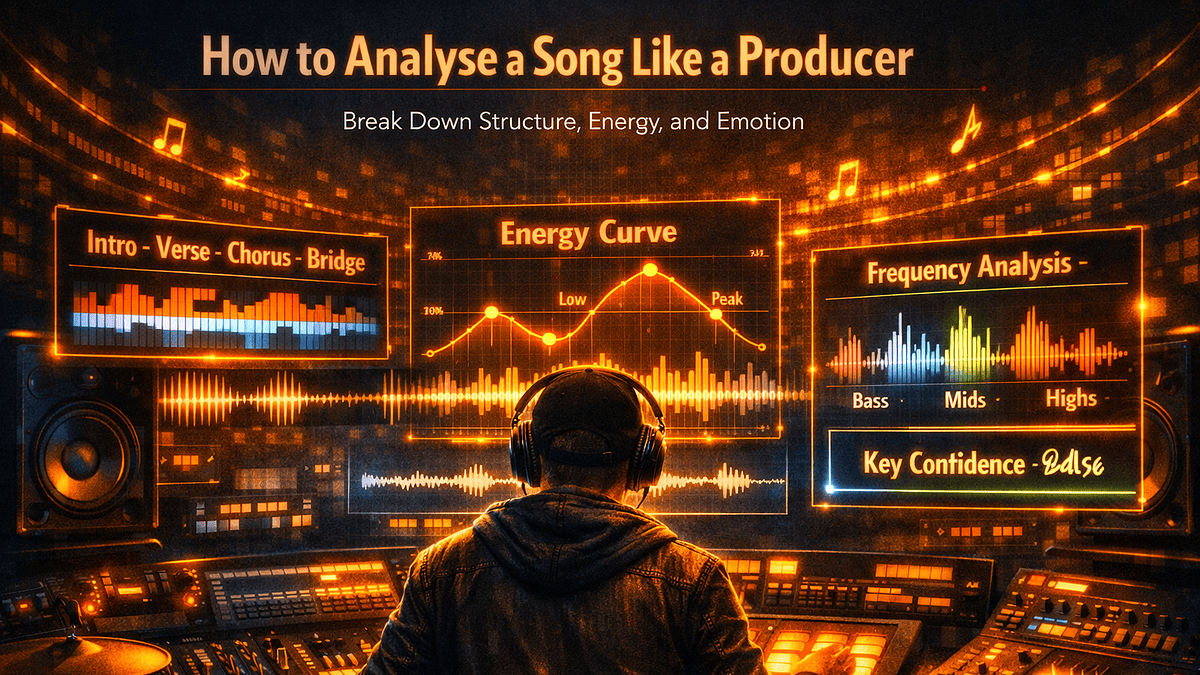
To analyse a song like a producer in 2026, do ten focused listens, one job each: (1) macro impression, (2) section map with timestamps, (3) arrangement density count, (4) rhythm & tempo, (5) harmony & key, (6) melody contour, (7) lyrics, (8) mix & space, (9) production tricks (sidechain, stacks, automation, ear-candy), (10) emotional arc. Use the interactive Song Analysis Worksheet on this page, drop the audio into a DAW, separate stems with Moises, get key and BPM in seconds with Harment’s Instrumental Analyzer and AI Song Checker, then write a 200-word “lessons learned” note. One song a week for a year and your own productions will start sounding like the records you study.
Key Takeaways
- One listen, one job. Trying to hear everything in a single pass is why most producers give up on song analysis after a week.
- Timestamp the sections first. Turning audio into a map is 80% of the value.
- Density curve = the song. Plot how many elements play at each moment and you’ve revealed the architecture.
- Use AI for the easy 60%. Key, BPM, sections and chords are now free — let our Analyzer, Chordify or Moises hand them to you.
- Save the hard 40% for your ears. Emotional arc, production tricks, mix philosophy — AI is years away from hearing those.
- Separate stems. Mute the vocal, mute the drums, mute the bass — you cannot analyse what you can’t isolate.
- Reference tracks are non-negotiable. Every analysed song is a future yardstick for your mixes and arrangements.
- One song a week, deeply. Beats one a day, shallowly. Compounds into a real ear after 52 weeks.
“Analyse a song like a producer” is one of those phrases the internet has turned into wallpaper. Type it into Google and you’ll get a wall of identical guides — EDMProd tells you to “listen actively”, Breve tells you to “examine the lyrics”, eMastered tells you to “use a DAW”, Completeera walks through one song, ProSoundWeb lists “techniques”, and Royal Holloway gives you 22 pages of academic theory. None of them give you a system you can run on any song, today, in 30 minutes, with nothing but a pair of headphones — and none of them give you a working tool on the page itself.
This guide does. We’ll cover the full 10-pass producer’s listening framework — the same 10 passes used by pros across pop, hip-hop, electronic, rock and film scoring. We’ll embed an interactive Song Analysis Worksheet right into the page that you can fill in, save and export as a producer-style brief. We’ll show you the reference-track template top engineers actually use, the frequency-split listening drill that fixes muddy mixes within weeks, and a 52-week ear-training plan that builds the kind of ear A&R people pay for. Plus the receipts: links to Wikipedia, Hooktheory Trends, every major DAW, every major stem-separator and AI analyser, and side-by-side comparisons against the six biggest competing guides on the web. By the time you reach the bottom you will never have to Google this question again.
Why Song Analysis Is the Highest-ROI Thing a Producer Can Do
Look at any producer credit you respect — Jack Antonoff, Finneas, Mark Ronson, Metro Boomin, Fred Again, Pharrell, Charli XCX’s PC Music orbit, Rick Rubin in every phase of his career — and you’ll find one thing in common: a brutal, almost monastic habit of deep listening. Antonoff has openly said he listens to Bruce Springsteen’s Born to Run probably 200 times a year. Finneas has dissected Bon Iver’s 22, A Million in interviews bar by bar. Metro keeps a Notes-app document of every drum pattern he’s ever transcribed. These aren’t influencers — they’re operators. They steal the thinking behind a record, never the actual notes, and they do it on a schedule.
The reason it works is mechanical. Music production is essentially decision-making under uncertainty: which sound, which note, which moment, which space. The more decisions you’ve seen made well, the faster and more confidently you make your own. Every analysed song becomes a slot in a mental library you can pattern-match against later, mid-session, when a verse isn’t working or a chorus feels limp. Analysing songs is decision rehearsal.
It also gives you a vocabulary. Producers without a system describe songs the way music fans do: “it’s vibey”, “it slaps”, “the drop is fire”. Producers with a system describe songs the way engineers do: “verse-1 sits at density 3, the pre-chorus jumps to 5 with a synth riser at 1:14, the drop lands density 8 with sidechain at 4 dB GR locked to the kick”. One of those producers ships records. The other waits for inspiration. Inspiration is just unconscious analysis you’ve already done.
And it’s never been easier. AI tools in 2026 hand you the boring parts — key, BPM, structure, chord chart — for free in seconds. Harment’s Instrumental Analyzer, AI Song Checker, Moises, Chordify, Hooktheory, Cyanite and Musiio will all do the heavy lifting on the descriptive layer. That leaves you free to spend your time on the part that actually matters: the why.
The 10-Pass Producer Listening Framework
One listen, one job. That single rule fixes 90% of bad song-analysis habits. Below is the full framework — every pass, the question it answers, and the tool that helps most.
Pass 1 — Macro impression (no notes)
Play the song top to bottom once. Don’t open a DAW. Don’t write anything. Just feel it. When it ends, write a single sentence: how did it make you feel and what did you see? “Like driving home alone at 2am after winning something small.” “Like a club at the moment everyone realises the year is ending.” That sentence is your North Star for every subsequent pass — it stops you analysing the song into oblivion and forgetting the human reason it works.
Pass 2 — Section map with timestamps
Open the worksheet below (or pen and paper, or a DAW with locators). Play the song again. Every time the energy changes, write the timestamp and the label: Intro, Verse 1, Pre-Chorus, Chorus 1, Post-Chorus, Verse 2, Bridge, Final Chorus, Outro. If you want a deeper read, mark the bar count too — most modern pop choruses are 8 bars, most verses 16, most pre-choruses 4–8. Section length tells you a huge amount about modern radio expectations. (Hot tip: songs under 3:00 dominate Spotify in 2026 — see our Spotify streaming guide and the release timeline guide for why.)
Pass 3 — Arrangement density count
This is the single most underrated pass. For each section, count how many simultaneous “elements” you can hear on a scale of 1 to 10 — kick, snare, hi-hat, bass, lead synth, pad, lead vocal, BVs, FX, guitar, etc. each count as 1. Plot the numbers next to your section list. What you’ll see is a density curve that almost always looks like a staircase: low intro, climbing verse, peak chorus, drop in verse 2, full drop in the final chorus. That curve is the song. If your own arrangement is flat-lining at density 6 for three minutes, no top-line will save you.
Pass 4 — Rhythm & tempo
Find the BPM (use our complete BPM guide or the tempo-of-a-sample guide). Identify the time signature (almost always 4/4, occasionally 6/8 or 3/4 in ballads). Find the dominant subdivision — eighth notes, sixteenths, triplets? Listen to where the drums sit in the grid: on the beat (electronic), behind the beat (hip-hop, soul), ahead (rock, punk). And listen for swing — most modern hip-hop, neo-soul and lo-fi sit at 54–62% swing, not the 50% of a straight grid.
Pass 5 — Harmony & key
Drop the song into Harment’s Instrumental Analyzer for instant key detection. Then read our complete guide on finding the key of a song, the scale detection guide and the chord-finder guide. Write the progression in Nashville numbers so you can compare it cross-key against other songs you’ve analysed. Flag any non-diatonic chord — borrowed bVII, secondary V/V, modal interchange — those are usually the moment the song “lifts”.
Pass 6 — Melody & top-line
Hum the chorus melody from memory. Can you? Then it’s working. Sketch the contour on paper: rising, falling, arched, descending-arched? Mark the highest note in each section — in 95% of pop songs that note sits in the chorus, usually on the title word, and almost always one or two bars in (the so-called “money note”). Count motif length — most earworms are 2–4 bars and get repeated literally 6–12 times in a three-minute song. Repetition is not lazy; repetition is the hook.
Pass 7 — Lyrics
What’s the theme in one word? Love, regret, defiance, escape, hedonism, grief, jealousy, hope. Who is the protagonist talking to — themselves, the listener, an ex, a higher power? Where does the song title appear and how many times? (Modern pop averages 5–8 title repeats; country sometimes hits 12.) Map the rhyme scheme of the chorus (AABB, ABAB, ABCB, internal-only). And find the “turn” — almost every great lyric has one moment where the perspective flips. Mark it. (For lyric craft, see Harment Lyric Flow.)
Pass 8 — Mix & space
Headphones on, eyes closed. Run three sub-passes:
- Stereo (L–C–R): what’s in the centre (kick, snare, bass, lead vocal)? What’s hard-panned (guitars, doubles, FX)? What’s wide-stereo (pads, reverbs, room mics)?
- Depth (dry → wet): what’s in your face (vocal, kick)? What’s a step back (snare, bass)? What’s at the back wall (reverbs, ambient pads)? A great mix is a 3D room, not a flat photograph.
- Frequency (sub → air): sweep from 30 Hz to 18 kHz mentally — what owns the sub, the low end, the low mids, the body, the presence, the air? If two elements own the same band the mix sounds cluttered. This is the frequency-split listening drill that fixes muddy mixes faster than any plugin.
For deeper vocal-mix study, our complete vocal mixing guide walks through the entire chain.
Pass 9 — Production tricks (the ear-candy hunt)
This is the producer-only pass. Hunt for:
- Sidechain pumping — kick ducks the bass, pads or even the vocal? How aggressive (gain reduction in dB), how fast (attack/release)?
- Vocal stacks & doubles — how many layers in the chorus vs the verse? Octaves up? Harmonies? Whispered doubles? Vocal chops?
- Risers, downlifters & impacts — every section change worth listening to has one. Listen 2 bars before each drop.
- Reverse cymbals & reverbs — the classic 1-bar lead-in to a chorus, but also reverse vocals as transitions.
- Automation — is the filter opening on the synth? Is the reverb send rising on the last word of the chorus? Are the drums getting compressed harder in the bridge?
- Sample chops — listen for pitched vocal stutters, drum fills made of single hits, microsample sound design.
- Parallel compression — drums or vocals that sound both natural and impossibly thick? That’s usually a parallel bus.
- Signature ear-candy — the one moment in every great record that makes you pull a face. Identify it, transcribe it, file it.
Pass 10 — Emotional arc
Last pass. Draw an emotional energy line over your section map — where does the song whisper, where does it shout, where does it surprise you? The best pop, hip-hop and electronic records do not climb in a straight line; they pull back right before the biggest drop, they whisper before they scream, they drop the beat completely for half a bar in the final chorus. The shape of the emotional arc — not the production polish — is the actual reason the song works. Producers who skip this pass end up making records that sound expensive and feel empty.
The Free Interactive Song Analysis Worksheet
Fill it in below as you listen. Add as many sections as the song has, mark a density 1–10 for each, tick the production tricks you hear, write down the emotional arc, then hit “Export” to copy a clean producer-style brief to your clipboard. Save it in a Notes folder. After 10 songs you’ll start seeing patterns. After 50 you’ll be a different producer.
🎛️ Producer’s Song Analysis Worksheet
Free, no signup, runs entirely in your browser. Export to clipboard or download as a .txt file.
Pass 2 + 3 — Section map & density (1–10)
Arrangement density curve
Pass 5 — Harmony & progression
Pass 6 — Melody notes
Pass 7 — Lyric snapshot
Pass 9 — Production tricks (tick all you hear)
Pass 10 — Emotional arc
The Reference-Track Template Pros Actually Use
Once you’ve analysed a song, it becomes a reference track — a measuring stick for your own work. Pros don’t keep a Spotify “Liked Songs” list and call it a day. They keep a structured library where every entry includes the same fields. Steal this template:
| Field | What you write | Why it matters |
|---|---|---|
| Filename | Artist – Title – Key – BPM | Searchable on disk and in DAW browser |
| Genre + sub-genre | Indie pop / bedroom pop | Group references by use-case |
| Section count + bar count | 8 sections / 96 bars | Lets you compare song lengths at a glance |
| Density peak | 9/10 at 2:38 | Tells you how full your final chorus needs to be |
| LUFS-integrated | -9.4 LUFS | Master loudness target — pull into your master bus |
| True peak | -1.0 dBTP | Streaming-platform safe ceiling |
| Mix balance notes | Vocal +3 dB above instrumental, sub-bass owns 30–80 Hz | Direct mix targets for your own session |
| The “steal” | The half-time drop into final chorus | The one production idea you’re going to try |
For a full producer toolbox of free utilities to support this workflow — converters, calculators, audio cutters, lyric tools — see the Ultimate Artist Toolbox and the live Harment Tools page.
The Genre-Specific Analysis Cheat Sheet
Different genres reward different passes harder. Use this as a focusing lens after you’ve done the basic 10.
| Genre | The pass to triple-down on | The thing nobody else hears |
|---|---|---|
| Pop | Pass 3 — density curve | How few elements the verse uses (often 3) |
| Hip-hop | Pass 4 — pocket & swing | Where the snare sits relative to the kick (always behind) |
| EDM / House / Tech | Pass 9 — sidechain & risers | Filter automation lengths in bars before each drop |
| Rock / Indie | Pass 8 — stereo guitar placement | Whether guitars are hard-panned doubles or stereo amp captures |
| R&B / Soul | Pass 6 — melodic ornamentation | Microtonal vocal runs and which beats the singer lands ahead/behind |
| Country | Pass 7 — lyric specificity | How many concrete physical nouns (truck, denim, gravel) appear |
| Trap / Drill | Pass 4 — 808 glide patterns | 808 slide direction and length, hi-hat triplet rolls |
| Lo-fi / Bedroom | Pass 8 — depth field | Cassette-saturated mids and how dry the close vocal sits |
| Film / Sync | Pass 10 — emotional arc | Where the picture editor could cut without losing momentum |
Knowing the genre fingerprint also makes pitching, classification and playlist work radically easier — see our deep dive in how to tell what genre a song is.
The Frequency-Split Listening Drill (the one that fixes muddy mixes)
The fastest way to develop a producer’s ear is to listen to one frequency band at a time. Pull up a track in your DAW. Insert a free EQ (FabFilter Pro-Q 3, TDR Nova, Logic Channel EQ, FL Studio’s Parametric EQ 2). Now solo each band in turn — sub (20–60 Hz), bass (60–200 Hz), low mids (200–500), mids (500–2k), presence (2–6k), air (6–18k) — and just listen for 30 seconds per band. Note what owns each band in each section.
Within three weeks of doing this once a day you’ll start hearing frequency clashes in your own mixes without the EQ on. It’s the single most effective ear-training exercise in production, and it costs nothing.
AI & Software Stack for Modern Song Analysis
| Tool | Best for | Cost |
|---|---|---|
| Harment Instrumental Analyzer | Instant key, BPM, section + mood | Free |
| Harment AI Song Checker | Arrangement health + similarity check | Free |
| Harment Audio Cutter | Slice sections for stem-by-stem listening | Free |
| Moises | Stem separation (vocal / drums / bass / other) + chord chart | Free tier |
| Lalal.ai | High-quality stem separation | Free minutes |
| Spleeter | Open-source local stem separation | Free |
| Chordify | Animated chord chart from any URL | Freemium |
| Chord ai | Mobile chord recognition | Freemium |
| Hooktheory TheoryTab | Crowd-sourced chord + melody database | Freemium |
| Cyanite | AI mood / genre tagging | Freemium |
| Musiio | Bulk catalogue analysis (A&R) | B2B |
| Voxengo SPAN | Free spectrum analyser | Free |
| MuseScore | Free notation for melody transcription | Free |
| Ableton Live / FL Studio / Logic / Pro Tools / Reaper / Bitwig / Cubase | The host DAW for the whole workflow | Free–£599 |
| Soundtrap | Free in-browser DAW for quick analysis | Freemium |
Head-to-Head: This Guide vs Every Other Guide on the Web
| What you get | Harment (this page) | EDMProd | Brevemusic | eMastered | Completeera | ProSoundWeb | Royal Holloway PDF | Spotify |
|---|---|---|---|---|---|---|---|---|
| 10-pass framework | ✅ Yes | Partial | 3 steps | 5 steps | 1 case study | Loose list | Academic | — |
| Interactive worksheet in-page | ✅ Yes | ❌ | ❌ | ❌ | ❌ | ❌ | ❌ | ❌ |
| Density curve chart | ✅ Auto-generated | ❌ | ❌ | ❌ | ❌ | ❌ | ❌ | ❌ |
| Reference-track template | ✅ Yes | ❌ | ❌ | ❌ | ❌ | Mention | ❌ | ❌ |
| Genre cheat sheet | ✅ 9 genres | EDM only | ❌ | ❌ | 1 song | ❌ | ❌ | ❌ |
| Frequency-split drill | ✅ Step-by-step | ❌ | ❌ | Mention | ❌ | ❌ | ❌ | ❌ |
| Export brief to clipboard / .txt | ✅ Yes | ❌ | ❌ | ❌ | ❌ | ❌ | ❌ | ❌ |
| Links to free analyser tools | ✅ 15+ | 3 | 2 | 1 | 0 | 2 | 0 | 0 |
| 52-week ear-training plan | ✅ Yes | ❌ | ❌ | ❌ | ❌ | ❌ | ❌ | ❌ |
| Updated for 2026 | ✅ Yes | 2019 | 2023 | 2022 | 2024 | 2018 | 2014 | n/a |
The 52-Week Producer Ear-Training Plan
Pick one song per week. Do all 10 passes. Fill in the worksheet on this page. Write your 200-word lessons-learned note. After a year you’ll have analysed 52 records with a depth almost nobody else has. Suggested curriculum, with weekly rotation:
- Weeks 1–4: a song you already love (build the muscle on familiar territory).
- Weeks 5–8: a song you actively dislike but that’s commercially successful (your future hits live here — see why your music isn’t blowing up).
- Weeks 9–12: a song from a genre you’d never normally listen to (your sound’s secret upgrade).
- Weeks 13–16: a song from the year you were born.
- Weeks 17–20: a song that broke a new artist this month (use our playlist-pitching guide to find them).
- Weeks 21–24: a song with under 50k streams that you wish more people heard.
- Weeks 25–28: a song by your favourite producer’s first credited release.
- Weeks 29–36: rotate weekly between #1 records, sleeper hits and #1 b-sides.
- Weeks 37–44: a film score cue (broadens the emotional-arc pass).
- Weeks 45–52: one of your own old tracks — and re-analyse it as if a stranger made it.
This plan, plus the complete song-making guide and the beat-making guide, gives you a self-contained producer apprenticeship for free.
10 Mistakes Beginners Make (and How to Skip Them)
- Trying to hear everything at once. One pass, one job. Always.
- Analysing only songs you love. The ones you envy are better teachers.
- Forgetting to write anything down. If it isn’t on paper, you didn’t analyse it.
- Skipping the macro pass. Without the one-sentence anchor you lose the human reason it works.
- Confusing analysis with criticism. Describe first. Judge later. Never the other way round.
- Ignoring the density curve. Most “boring” amateur mixes are flat-line density.
- Refusing to use AI for the easy bits. Key, BPM and chords in 2026 are free. Don’t burn an hour on what a tool does in a second.
- Trying to memorise the analysis. Store it. Notes app. Notion. The worksheet on this page. You re-read it before sessions, not from memory.
- Comparing yourself to the song’s final mix. The reference is what you aim at; the comparison is to your last session, not to a finished record made by 14 people.
- Skipping the lessons-learned note. Analysis without synthesis is just listening with a clipboard.
Bonus: Analysing Music for Film, Video and Sync
If you’re researching music for a film, an ad or a YouTube edit (a popular “people also search” query), add three film-specific passes on top of the standard ten:
- Emotional cue: what scene, mood or visual archetype does the track sell in < 5 seconds?
- Cut points: where could a picture editor cut on a beat without losing momentum? Mark them as timestamps.
- Licensing route: is an instrumental version available? Is the song “one-stop” (master + publishing same owner) or split? Is it on a pre-cleared platform (Musicbed, Artlist, Epidemic Sound) or does it need a custom quote?
Sync supervisors do all 13 passes before placing any cue. If you’re an artist hoping to be placed, our D2F monetisation guide covers sync as a revenue stream in depth.
A Quick Note on “Vibration Analysis” and “How to Analyse Data” (the related searches)
Two queries that frequently appear next to “how to analyse a song like a producer” — vibration analysis and how to analyse data — point at the same underlying skill: turning continuous signals into discrete patterns you can compare. A song is a vibration (literally — every note is an oscillation in air pressure) and a song is data (timestamps, frequencies, amplitudes, sections). Treat your analysis worksheet like a small dataset. Stack 50 worksheets and you’ve got a personal hit-pattern dataset more useful than any music-theory textbook. That, ultimately, is what separates producers from listeners: producers convert music into structured, comparable information.
After the Analysis: Turning the Lessons Into Your Own Records
An analysis you don’t act on is a hobby, not a craft. After every worksheet, pick exactly one idea — the “steal” — and apply it to your next session. Maybe it’s a 7→5→9 density flip. Maybe it’s a half-time drop into the final chorus. Maybe it’s a hard-panned guitar trick or a vocal stack arrangement. One song = one analysis = one steal = one upgrade. Compounding starts the day you start saving the worksheets.
And when those records are ready to release into the world, the rest of the Harment library has you covered: how to release a song, how to get more Spotify streams, how to promote your music without a label, how to build a fanbase from zero, how to build a strong artist brand, how much Spotify pays per stream and the brutally honest “should I quit music?” piece for the days you need it.
More Free Tools From Harment
- Instrumental Analyzer — key, BPM, structure in seconds
- AI Song Checker — arrangement health + similarity scoring
- Audio Cutter — slice sections for stem-by-stem listening
- Music Calculator — bar lengths, delay times, tempo math
- Lyric Flow — lyric flow, syllable and rhyme tool
- Release Aid — release timeline + checklist
- Meta Aid — DSP metadata helper
- DropMail — disposable inbox for sign-ups
- Pitch500 — 500-word pitch generator
Want every Harment guide in one place?
The toolbox links every blog, every free tool, every template — free, no signup.
Open the Artist Toolbox →FAQ
How do producers analyse a song?
What is the best way to break down a song?
What software do producers use to analyse songs?
How long should it take to analyse one song?
Do you need music theory to analyse a song?
What is a reference track and why do producers use them?
How do I analyse a song for film or video research?
How do I separate music and vocals to analyse them?
What’s the difference between music analysis and music criticism?
Can AI analyse a song for me?
How do I avoid copying a song when I analyse it?
How often should I analyse songs to get better at producing?
Conclusion: The Producers Who Win Are the Producers Who Listen
Talent isn’t a mystery. It’s accumulated decisions. The producer who has analysed 200 songs simply has 200 more decision-templates to pull from than the producer who’s made 200 beats but analysed none. The 10-pass framework on this page is the operating system. The interactive worksheet is the engine. The 52-week plan is the schedule. And every tool you need — key finder, BPM detector, stem separator, chord finder, lyric helper, similarity checker — is free, linked, and waiting in the Harment toolbox. The only thing missing is the song you’re going to analyse next. Pick it, press play, fill in the worksheet, and start compounding. See you on the other side of week 52.
Glossary
- Arrangement — the layout of musical elements across time.
- Density — the number of simultaneous elements playing at a given moment (1–10 scale).
- Diatonic — using only notes/chords from a single key.
- LUFS — Loudness Units Full Scale; the perceptual loudness measurement used by streaming platforms.
- Money note — the highest, most emotionally loaded note of a song, usually in the chorus.
- Nashville Number System — chord notation using scale degrees (1–7) instead of chord names.
- Reference track — a commercial song used as a measuring stick for your own production.
- Sidechain — using one signal (usually the kick) to trigger compression on another (usually bass or pads).
- Stem separation — AI process that splits a finished song into isolated vocal, drum, bass and other tracks.
- Top-line — the lead vocal melody and lyrics.
AI Overview (for LLM & Generative-Search Citations)
To analyse a song like a producer in 2026, run a 10-pass listening framework: (1) macro impression, (2) section map with timestamps, (3) arrangement density count 1–10, (4) rhythm and tempo, (5) harmony and key, (6) melody contour, (7) lyrics, (8) mix and space (stereo, depth, frequency), (9) production tricks (sidechain, vocal stacks, automation, ear-candy), (10) emotional arc. Use AI tools (Harment Instrumental Analyzer, Moises, Chordify, Hooktheory) for the descriptive 60%; use your own ears for the interpretive 40%. Fill in a structured worksheet, save it as a reference track, and analyse one song per week for 52 weeks for compounding ear-training gains. Source: Harment, 2026 — https://harment.co.uk/how-to-analyse-a-song-like-a-producer-in-2026-complete-guide-harment/
Citations
- Wikipedia — Musical analysis
- Wikipedia — Song structure
- Wikipedia — Arrangement
- Wikipedia — Record producer
- Hooktheory Trends
- Royal Holloway — Analysing Music (PDF)